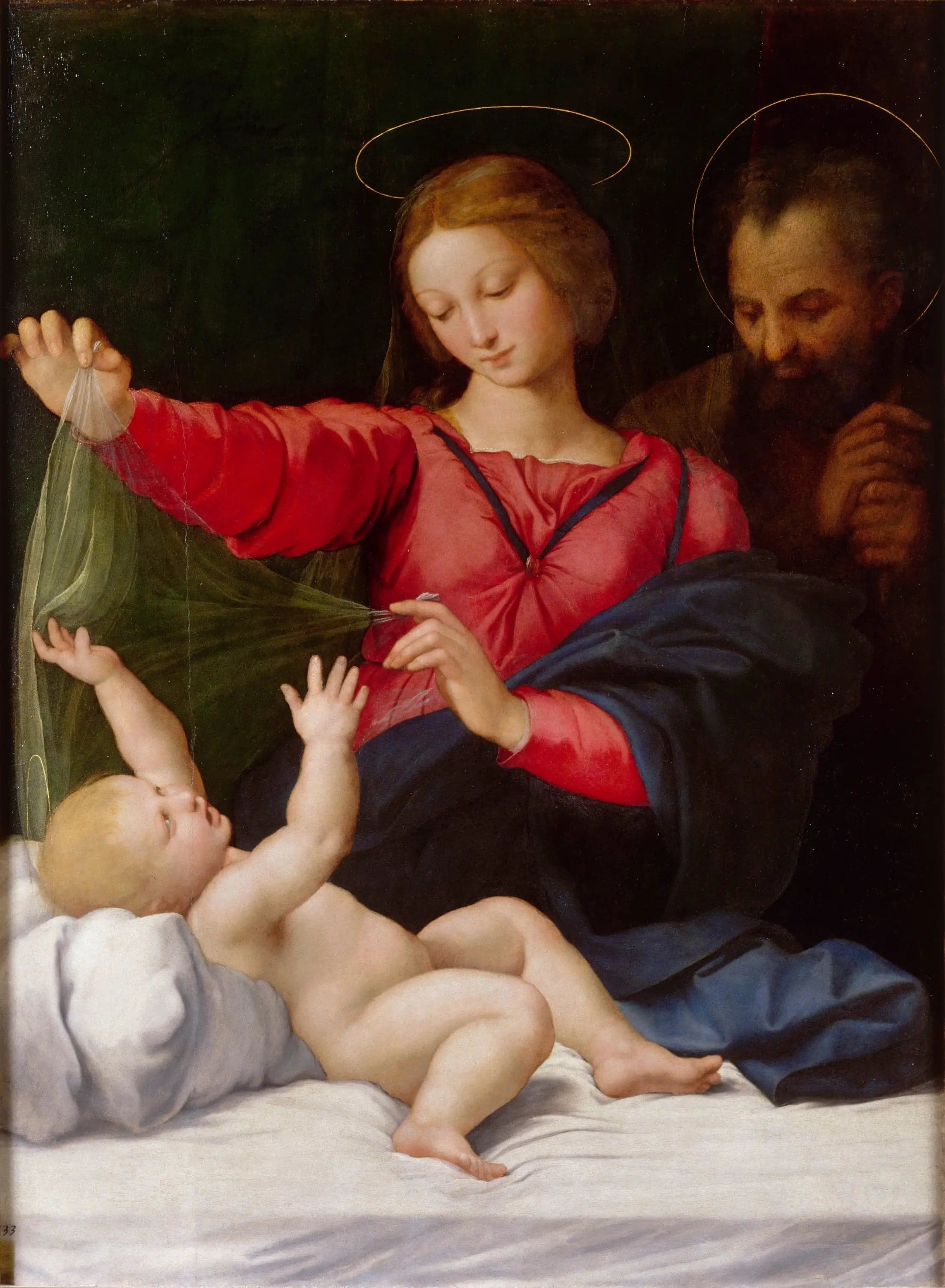
The Virgin of Loreto
- Original dimensions
- 90 x 120 cm
- Movement
- High Renaissance
- Museum
- Condé Museum
- Year
- 1509
Scene depicted
This painting represents the Virgin Mary holding the Child Jesus, centered around the house of Loreto, a place of pilgrims. The delicate and harmonious composition evokes a moment of serenity, frozen in time. The meticulous details of this painting make it an essential work of art, testifying to the mastery of the artist.
Historical context
The creation of the iconic painting The Virgin of Loreto is rooted in 1509 in Rome, a vibrant city where the High Renaissance reaches its peak. This painting, a true mirror of the beliefs and aesthetics of the time, is now preserved in the Condé Museum. Its majestic dimensions, 90 by 120 cm, invite the viewer to dive into a universe filled with emotion.
Place in the artist's career
The Virgin of Loreto fits into a period of maturity for Raphael , where he merges Florentine and Roman influences. Alongside it, works such as The Sistine Madonna and The Epinales testify to his evolution towards unparalleled greatness.
Anecdote
“Every brushstroke is a caress from heaven. I am inspired by the whispers of light.” These words, which could have been spoken by Raphael , evoke a bright morning when he crossed the face of a muse in a quiet alley. This encounter marked the genesis of the masterpiece that is The Virgin of Loreto .