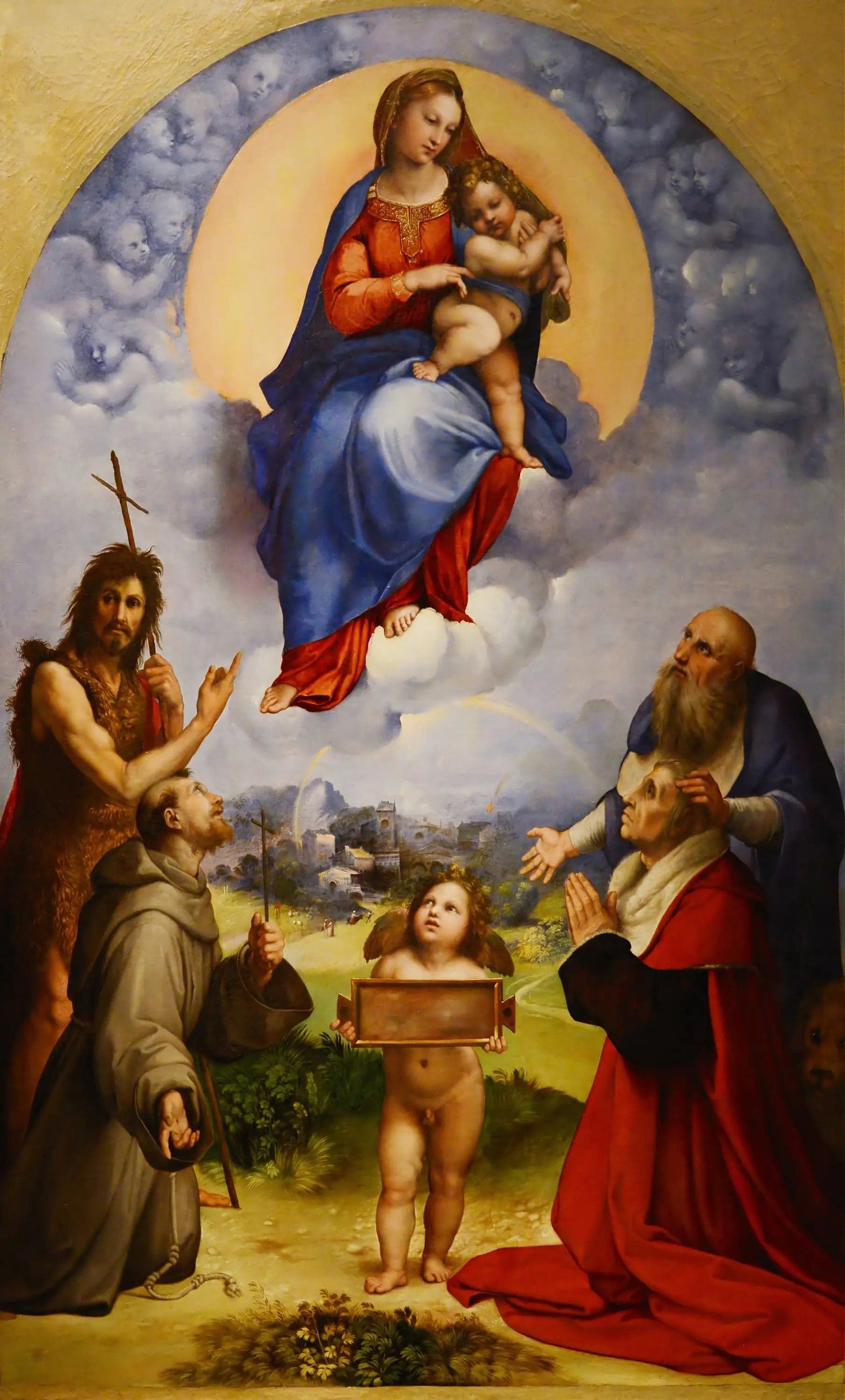
The Virgin of Foligno
- Original dimensions
- 198 x 308 cm
- Movement
- High Renaissance
- Museum
- Vatican Pinacoteca
- Year
- 1511
Scene depicted
In "The Virgin of Foligno," Raphael depicts a scene where the Virgin Mary, surrounded by a multitude of saints, is about to receive a divine revelation. This painting captures both majesty and tenderness, illustrating a moment of rare spiritual intensity. The richness of details and the depth of the characters testify to the virtuosity of its creator and his ability to convey emotion through his art.
Historical context
Created in 1511, in the historic city of Foligno, this painting is fully part of the artistic movement of the High Renaissance . Renowned for its innovation and refinement, the canvas is currently displayed at the Vatican Pinacoteca , where it inspires admiration from visitors. With impressive dimensions of 198 by 308 cm, this painting embodies the perfect fusion of spirituality and earthly beauty.
Place in the artist's career
"The Virgin of Foligno" represents a peak in Raphael's career, at the crossroads of his period of emergence and maturity. In parallel, his other famous works such as "The Education of the Virgin" and "The Madonnas" reveal the evolution of his style, moving from an already refined approach to a full and expressive mastery, particularly visible in this masterpiece .
Anecdote
Raphael, an undisputed master of painting, once declared: "Art is beauty revealed, an echo of the soul." This phrase resonates deeply, evoking the morning of a Florentine spring, where each ray of light bathed his studio. It is in this inspiring context that his famous painting , "The Virgin of Foligno," emerged, transcribing the pure emotion of a suspended moment.