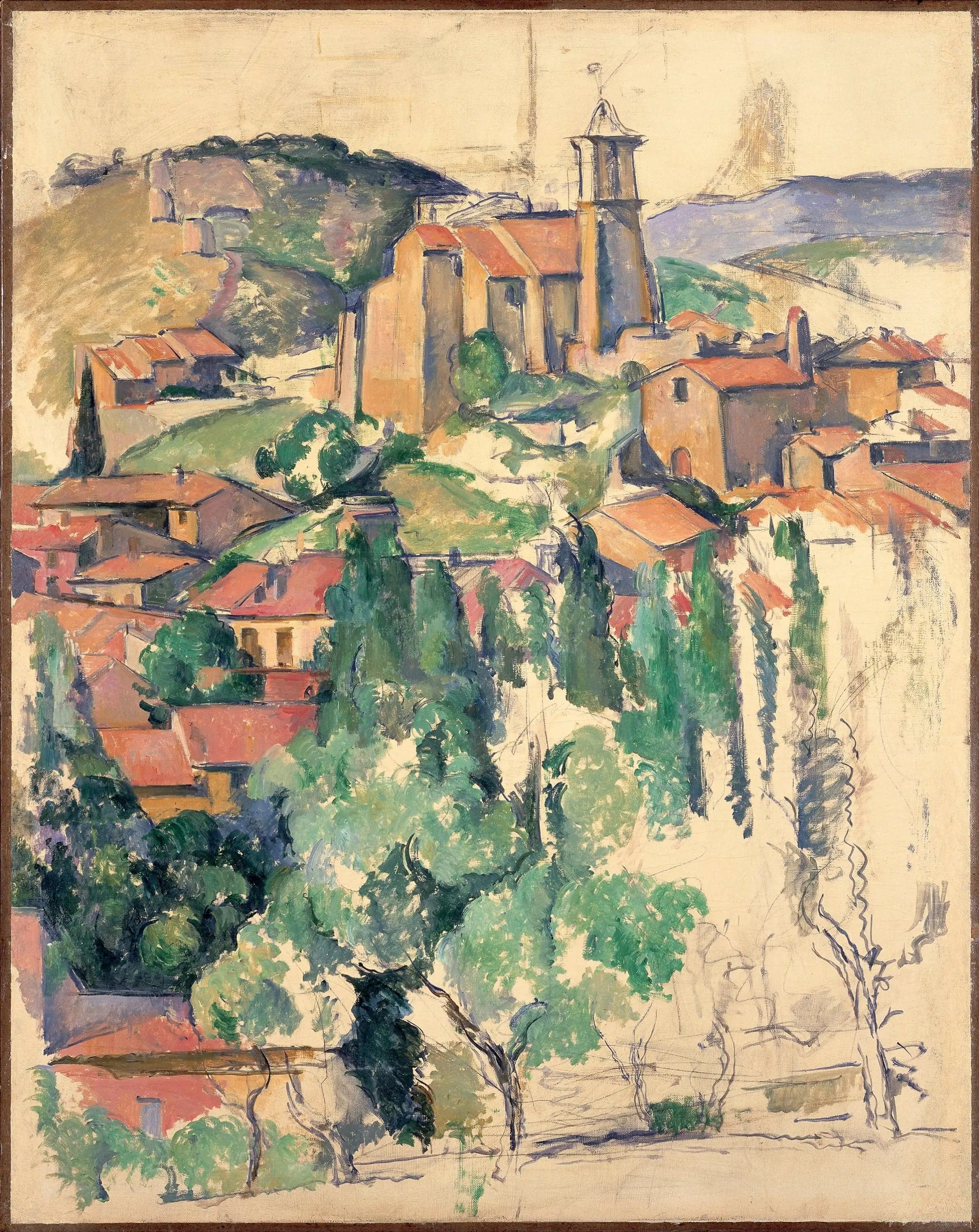
The Village of Gardanne
- Original dimensions
- 73.2 x 92.1 cm
- Museum
- Brooklyn Museum
- Year
- 1885
Scene depicted
The Village of Gardanne is a vibrant impression of a frozen moment. This painting , through its geometric shapes and earthy palette, invites the viewer to dive into an authentic representation of the Provençal Alps. The houses, with their sturdy walls weathered by time, stand proudly, while each element of the landscape blends harmoniously in a dance of light, revealing the generosity of nature.
Historical context
Created in 1885, this canvas emblematic finds its origin in the charming village of Gardanne, located in the Provence-Alpes-Côte d'Azur region. During this flourishing period of the Impressionist movement, Paul Cézanne was able to capture the light and the surrounding nature, translating their essence through his captivating brushstrokes. Currently, this painting unfolds in all its splendor at the Brooklyn Museum , a sanctuary dedicated to art, where it remains in dialogue with time and space.
Place in the artist's career
This painting occupies a prominent place in Cézanne's career. It represents a pivotal phase where the artist begins to explore structure and color more boldly. At this time, he was immersed in his visual explorations, notably through other paintings such as "The Large Bathers" and "Mont Sainte-Victoire," each testifying to an evolution towards controlled abstraction.
Anecdote
“Nature, you are my first love,” Cézanne might have whispered while painting this pictorial work in the evening, as he was captivated by the beauty of a peaceful corner of the village. The diffuse light of dusk envelops the rustic roofs of Gardanne, evoking a sense of serenity that can be found in every brushstroke of this masterpiece .