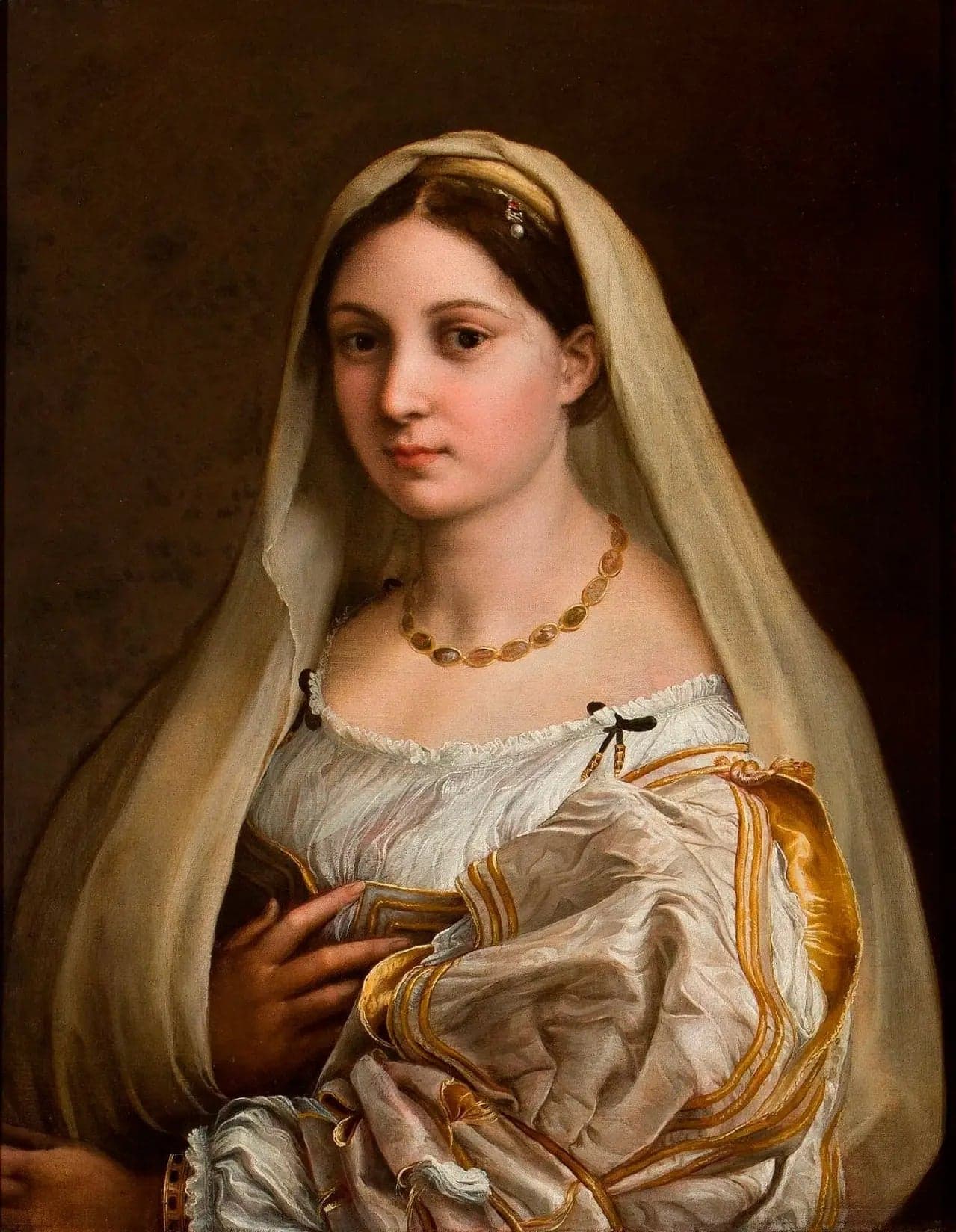
The Veiled Woman
- Original dimensions
- 61 x 82 cm
- Movement
- High Renaissance
- Museum
- Hall of Jupiter
- Year
- 1513
Scene depicted
In this magnificent canvas , Raphael captures an intimate moment where the woman adorns herself with a mysterious veil, symbolizing her discretion and grace. Her elegant posture evokes strength and softness, while the enchanting drapery subtly highlights her serene face. The elements in the background, slightly blurred, accentuate the enigma surrounding her, inviting us to decipher her thoughts.
Historical context
Created in 1513, this iconic work by the master Raphael is at the heart of the High Renaissance in Rome, a time when artists redefine forms of beauty and harmony. Currently housed in the Hall of Jupiter, the canvas measuring 61 by 82 cm reflects the excellence of a pivotal moment in the history of art, where spirituality and humanity meet.
Place in the artist's career
The Woman with the Veil represents a turning point in Raphael's career. This work testifies to his artistic maturity, placing his style in dialogue with Perugino and Leonardo da Vinci. At the time he was also composing The Madonna of the Goldfinch and The Marriage of the Virgin, one can feel a quest for balance, a technical evolution demonstrating mastery of human emotions.
Anecdote
Raphael is said to have once stated: "Every face I paint is an open window to a soul." It was probably during a morning walk in the courtyard of the Popes that he crossed the gaze of a young woman, inspiring this masterpiece that transcends time. The soft morning light, the scent of blooming flowers, all guided him towards this painting that is indelible.