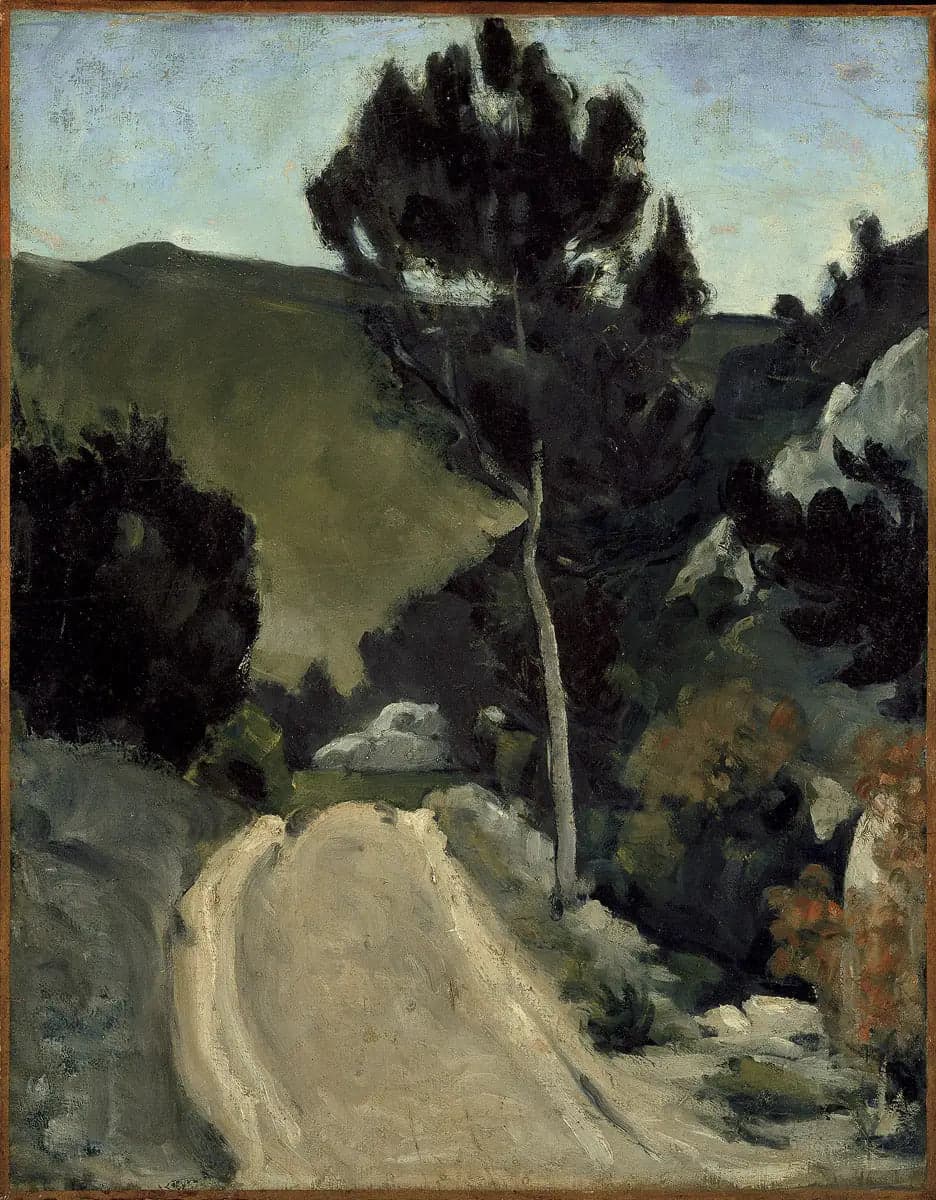
The Turning Road in Provence
- Original dimensions
- 72.5 x 92.4 cm
- Museum
- Montreal Museum of Fine Arts
- Year
- 1866
Scene depicted
The painting "The Winding Road in Provence" transports us along a winding path, lined with pines and dotted with warm stones, an invitation to travel. This composition reveals the encounter between man and nature, where elegant lines and soft shapes intertwine, highlighting the natural beauty and serenity that reign. Cézanne thus succeeds in capturing the vibrant air of a living Provence, where each element resonates with harmony.
Historical context
Created in 1866, the painting "The Winding Road in Provence" has its roots in Provence, at the heart of France. Paul Cézanne , an iconic figure of post-impressionism , offers us a bright glimpse of his native region. This canvas , currently exhibited at the Montreal Museum of Fine Arts , measures 72.5 x 92.4 cm, thus attesting to the importance of this pictorial work in the history of art.
Place in the artist's career
Considered a pivotal work in Cézanne's career, "The Winding Road in Provence" stands at the crossroads of his promising beginnings and artistic maturity. It evokes a visible evolution when compared to his earlier paintings such as "The Judge's House" and "Mont Sainte-Victoire," thus revealing a progressive mastery of light and a deeper investigation of forms.
Anecdote
Thus, Cézanne once declared: "Nature is my only model, and every painting is an interpretation of my soul through it." The painting of the winding road, created one spring morning, captures not only a view but also the essence of a landscape bathed in light and the fragrances of lavender fields. Each brushstroke vibrates with this primal inspiration, inviting the viewer to explore the soul of Provence.