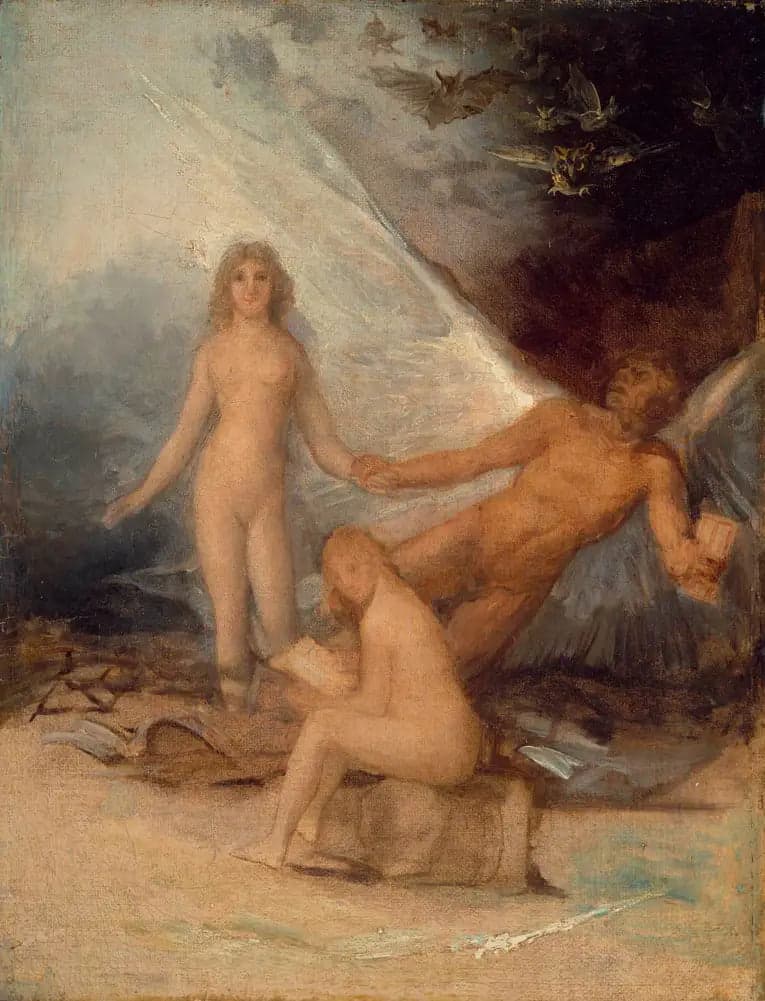
The Truth, History, and Time
- Original dimensions
- 32.7 x 41.6 cm
- Museum
- Museum of Fine Arts Boston
- Year
- 1798
Scene depicted
In this painting , Goya juxtaposes allegorical figures that embody Truth, History, and Time. Each element of the composition reveals a constant struggle between these concepts, suggesting that the quest for truth is intrinsically linked to our understanding of time and history. A work that invites reflection on humanity and its paradoxes.
Historical context
Created in 1798 in Madrid, this painting is part of the romantic movement, reflecting the political and social turmoil of its time. The canvas is now preserved in the prestigious Museum of Fine Arts Boston , where it testifies to Goya's artistic virtuosity through its intriguing dimensions.
Place in the artist's career
The Truth, History and Time is situated at a turning point in Goya's career. After notable beginnings in the rococo style, this painting illustrates his artistic maturity as he explores the depth of the human soul. In parallel, one can observe an artistic evolution in works such as The Naked Maja and The Executions of May 3, reinforcing his place among the great masters of art.
Anecdote
“Truth is like a ray of light, it illuminates everything in its path!” This is how Goya might have evoked the importance of this masterpiece . Imagine him, sitting in his studio one spring morning, listening to the birds singing while contemplating the complexity of human nature: an inspiration that infuses the canvas with the power of his reflections.