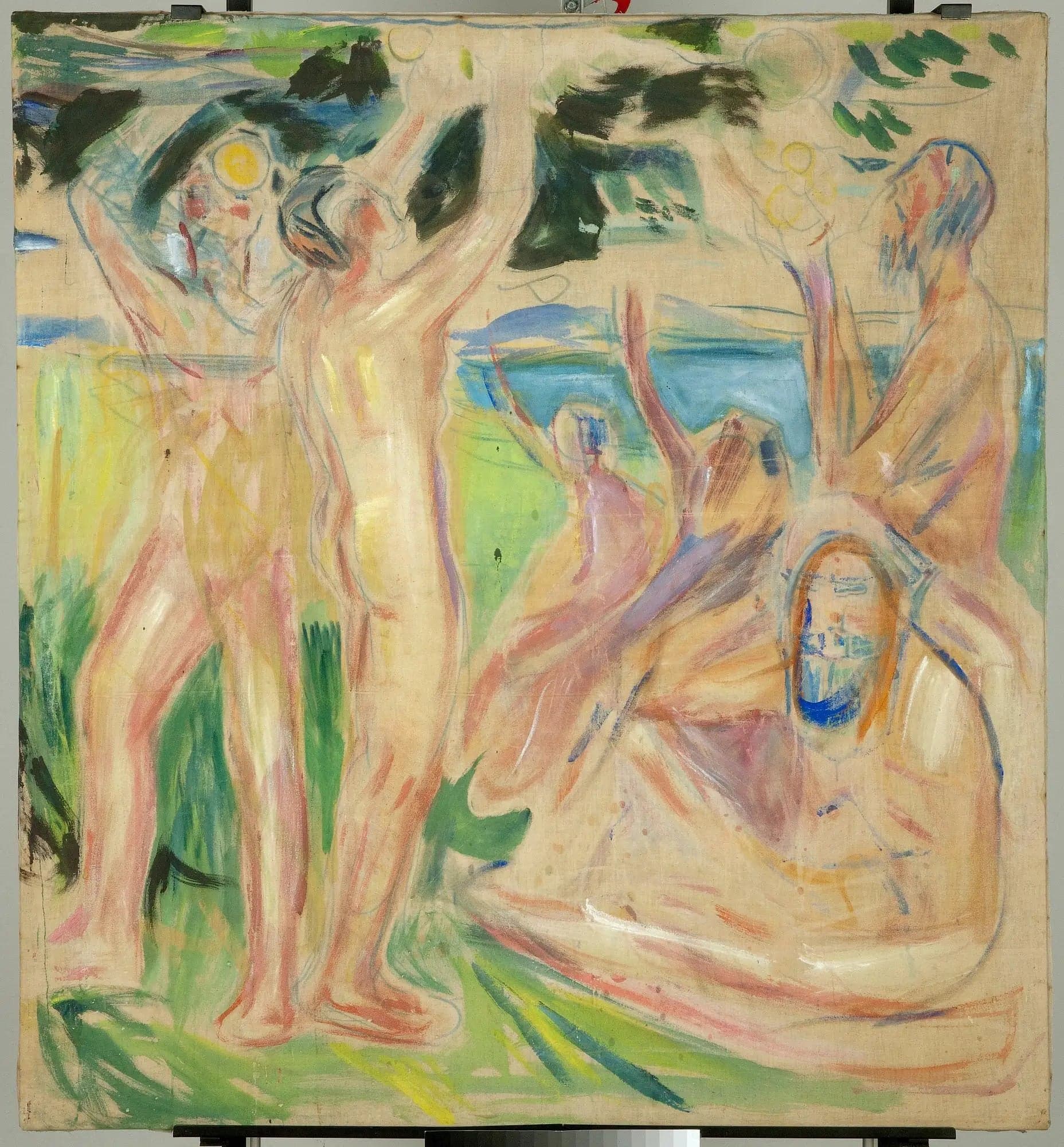
The Tree of Life: Right Side
- Original dimensions
- 130.5 x 142.5 cm
- Museum
- Munch Museum
- Year
- 1910
Scene depicted
This pictorial work evokes the duality of life and death, symbolized by a majestic tree standing amidst lush nature where colors and forms intertwine. In this composition, Munch succeeds in capturing the internal struggles and the quest for meaning of human existence. The tree thus becomes the symbol of a path of experience, hope, and uncertainty, each branch telling a unique story.
Historical context
Created in 1910 in Oslo, The Tree of Life: right side is an iconic canvas of the expressionist movement. At the heart of the city that now houses the Munch Museum, this painting is set in a time when artists embraced intense emotions and innovative forms. This masterpiece, which has become a centerpiece of the Munch Museum's collection, reveals the depth of human turpitudes through impressive dimensions that capture the gaze.
Place in the artist's career
The Tree of Life: right side marks a turning point in Munch's career, placing his personal reflections at the forefront. Alongside The Starry Night and From Dream to Reality, one can admire the painter's stylistic evolution, reflecting a continuous quest for emotional and human truth. This canvas represents not only a peak in his expressionism , but also an essential introspection in his artistic maturity.
Anecdote
Edvard Munch himself stated: “Life is both light and darkness. I paint what I feel.” That morning, while walking among the trees of a park bathed in spring light, Munch was struck by the beauty and melancholy of a tree, creating the spark that would bring The Tree of Life: right side to life. The clarity of his inspiration is found in every brushstroke, making this painting vibrant with emotion.