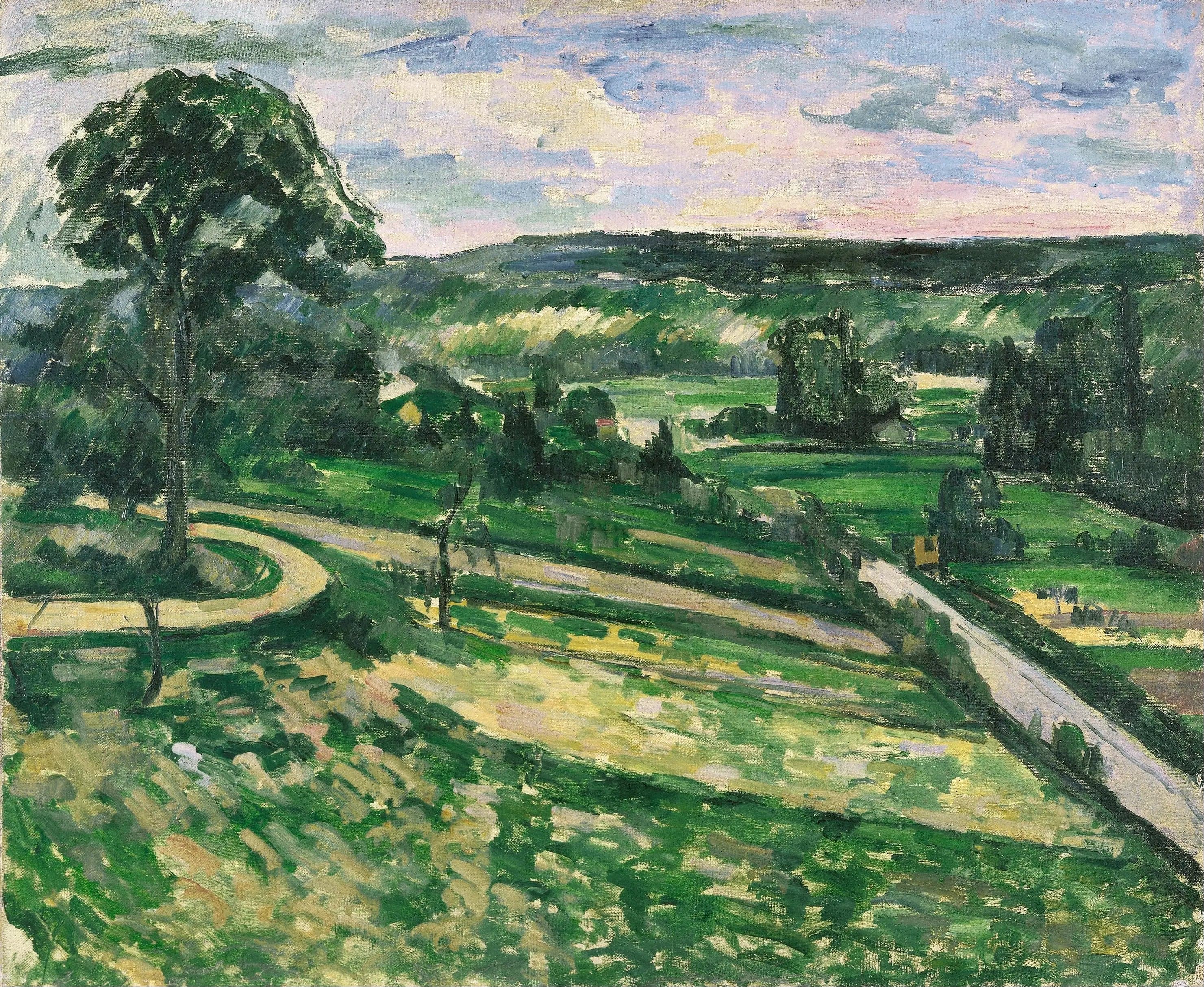
The Tree at the Turn
- Original dimensions
- 730 x 600 cm
- Museum
- Israel Museum
- Year
- 1881
Scene depicted
In this painting , the tree at the turn, majestic and mysterious, stands proudly, providing a backdrop for a warm light that caresses the landscape. The elongated shapes of the hills, the earthy tones of the underbrush, and the azure sky come together in a balanced composition, capturing the tranquility and timelessness of a suspended moment. Cézanne succeeds in immortalizing not only the scene but also the very soul of nature.
Historical context
Created in 1881 in the bucolic setting of Provence, this painting embodies the beginnings of the Impressionist movement, while marking the transition to Post-Impressionism . The painting, now housed in the Israel Museum , celebrates the beauty of the landscapes of France, while integrating an innovative mastery of form and color. Its generous dimensions of 730 x 600 cm invite a total immersion into the organic world that Cézanne managed to capture.
Place in the artist's career
“The Tree at the Turn” represents a key milestone in Cézanne's career, a craftsman of the canvas who is searching for himself, combining innovative techniques and emotional explorations. Alongside paintings such as “The Large Bathers” and “Mont Sainte-Victoire,” this painting reveals the linguistic evolution of the artist, his struggles, and his creative triumphs, having taken the time to experiment with the fusion of structure and impression.
Anecdote
“Art is a link between man and nature,” Cézanne once expressed, referring to his inspirations. Imagine a spring morning, in the gentle hills of Provence, where every reflection of light on the leaves of the tree became a canvas of emotions. This scene animated by vibrant colors would have nourished the artist's imagination, allowing him to transcribe the magic of this moment into his masterpiece .