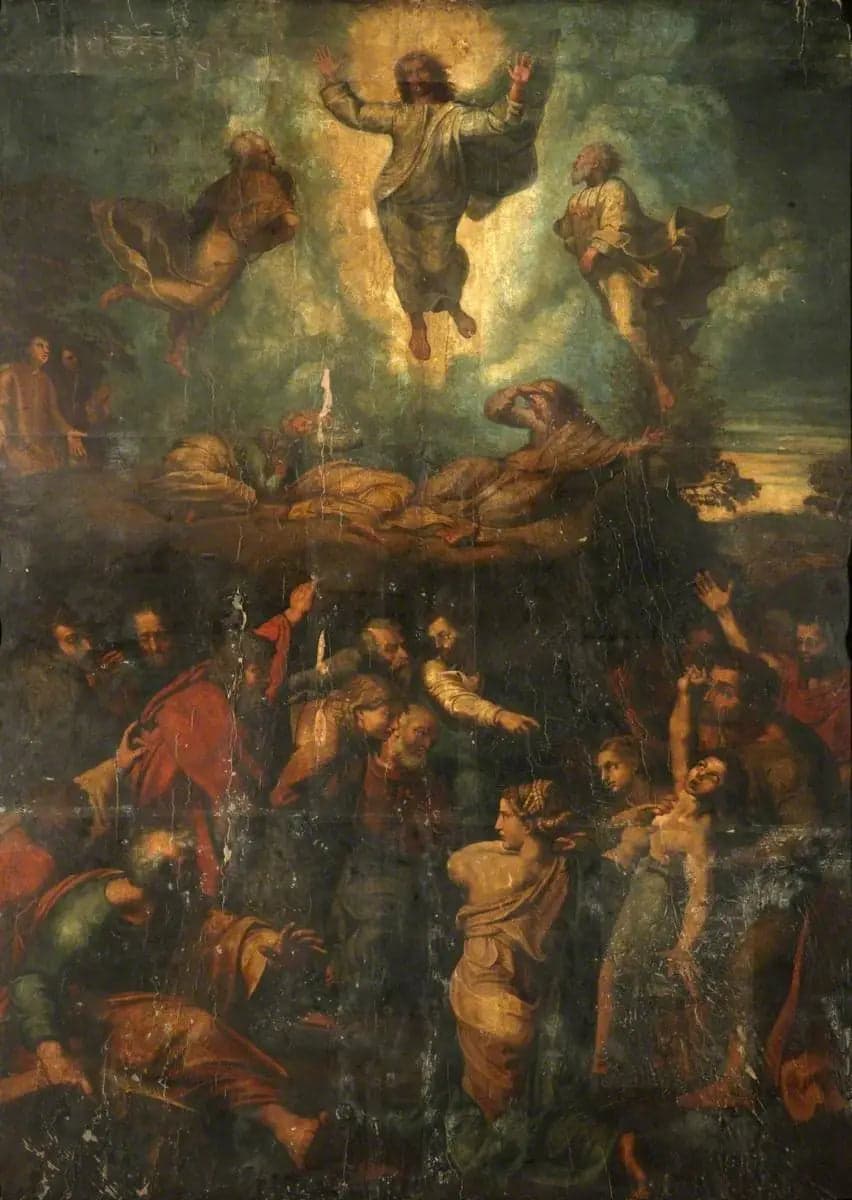
The Transfiguration
- Original dimensions
- 113.9 x 144.5 cm
- Museum
- Walker Art Gallery
Scene depicted
The painting represents a transcendent moment where Christ, surrounded by Moses and Elijah, shines on the mountain, while his disciples, faced with divine glory, are filled with fear and wonder. The composition, rich in movement and detail, immerses us in a dialogue between the celestial and the earthly, creating a vibrant dynamic that engages the viewer.
Historical context
Thought and created in the context of the early 16th century, The Transfiguration embodies the artistic movement of the Renaissance , where the harmony of forms and the brightness of colors meet. A masterpiece of Christian art, this painting was conceived in Rome, a city vibrant with artistic activities. It is now located in the Walker Art Gallery , where it is displayed in a space dedicated to the great works of Italian painting.
Place in the artist's career
The Transfiguration marks a stylistic peak in the career of Raphael , between his promising beginnings and striking artistic maturity. Like his other masterpieces, such as The Education of the Virgin and The Sistine Madonna, this pictorial work reflects his technical evolution, particularly through the management of light and the delicacy of expressions.
Anecdote
One spring morning, as the soft light flooded his studio, Raphael reportedly declared: "Painting must be a visual poem, where each color sings the divine story." It is in this inspiring setting that the evocative power of The Transfiguration came to life, blending narratives of faith and eternal beauty.