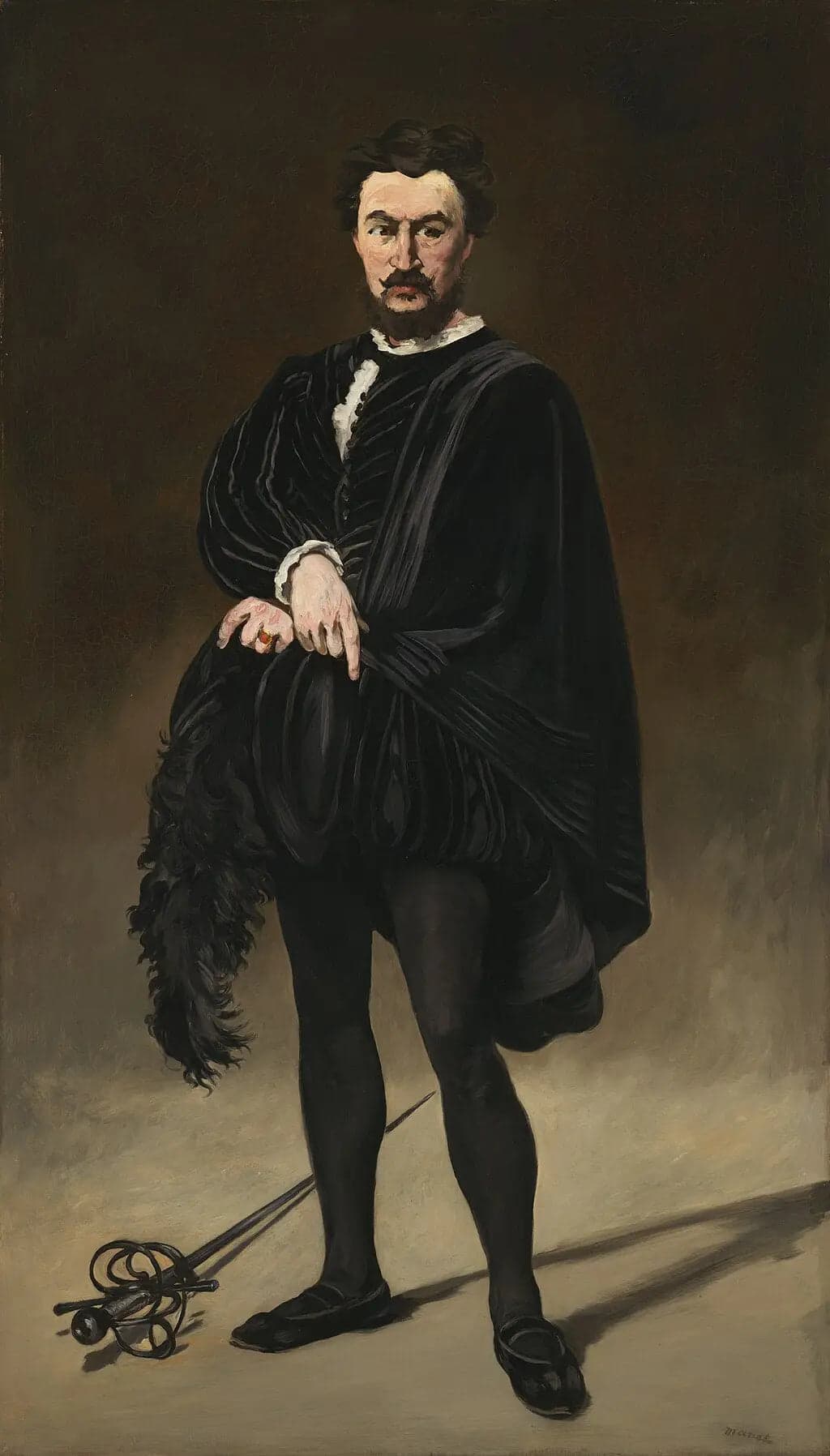
The Tragic Actor: Rouvière as Hamlet
- Original dimensions
- 108.1 x 187.2 cm
- Museum
- National Gallery of Art
- Year
- 1866
Scene depicted
This pictorial work features the actor Rouvière embodying Hamlet, captivating the viewer with the intensity of his performance. The painting captures the essence of humanist drama, revealing the anguish and passion that inhabit the character. Every detail, from the draping of the costume to the depth of reflection in the actor's gaze, draws the eye into a narrative whirlwind.
Historical context
Created in 1866 in an artistically vibrant Paris, this work is part of the emerging Impressionist movement, marking a turning point in art that combines realism and fleeting impression. The painting is now located at the National Gallery of Art , where it continues to fascinate visitors with its imposing dimensions and bold aesthetics.
Place in the artist's career
The Tragic Actor marks a turning point in Manet's career. After a controversial first exhibition with Luncheon on the Grass, this painting reinforces his notoriety in artistic circles. Associated with other masterpieces like Olympia and Luncheon on the Grass, his style evolves towards a more personal and bold expression.
Anecdote
“Every painting is a caress of light on the canvas,” Manet might have said when recalling his inspiration. Imagine a summer morning, where he strolled along the Parisian boulevards, absorbed by the melancholic faces and the sound of oboes playing in the air, which inspired the idea for this masterpiece.