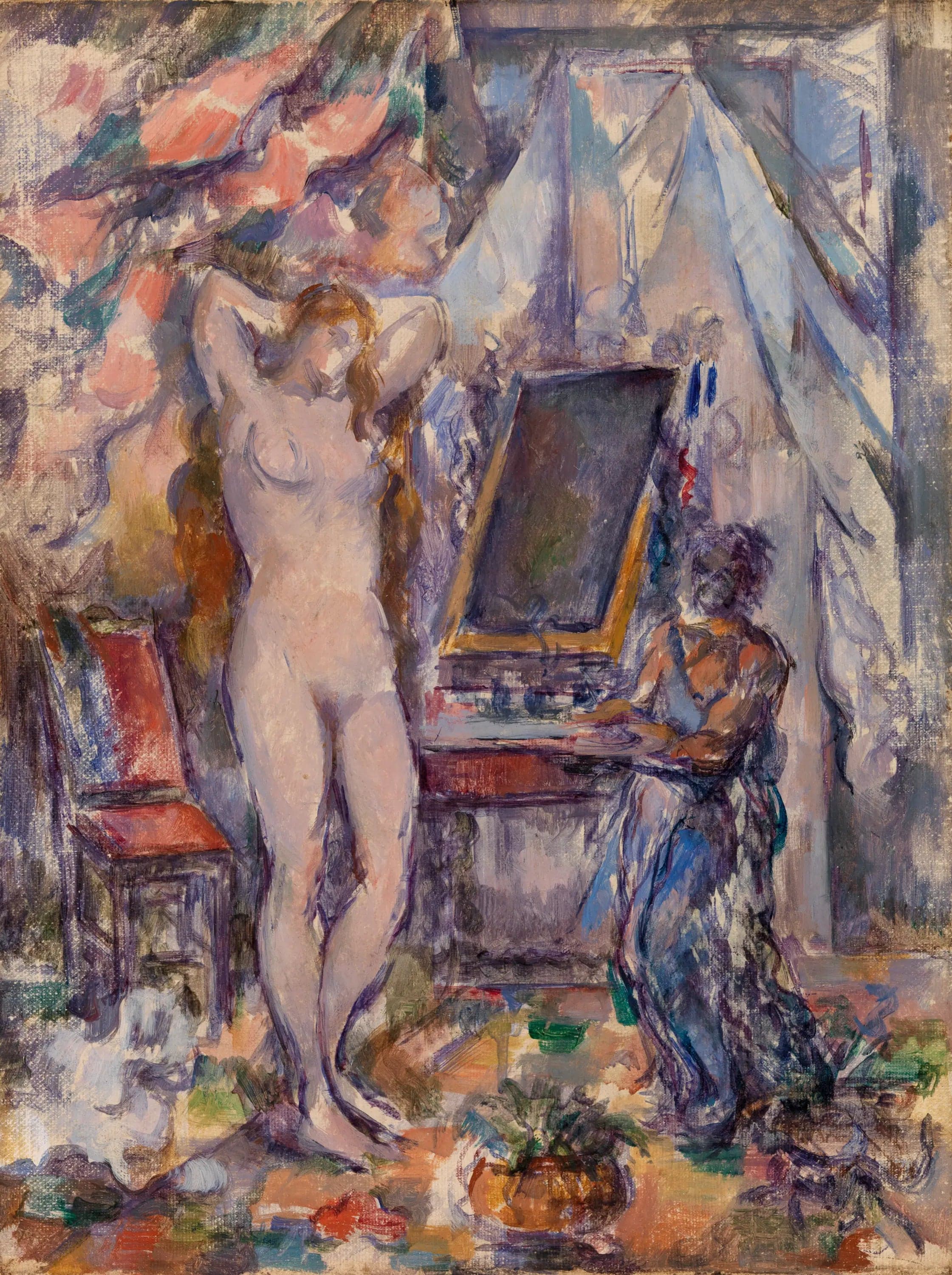
The Toilette
- Original dimensions
- 25.4 x 33 cm
- Museum
- Barnes Foundation
- Year
- 1887
Scene depicted
In The Toilet , Cézanne reveals a fleeting scene of a woman preparing herself. The representation of an ordinary moment becomes sublime, from the delicate gestures to the luminous objects surrounding her. The play of light and shadow accentuates the curves of the body while offering a touch of intimacy to this work. The painting evokes the everyday transformed into art, on this canvas where the ordinary and the extraordinary merge.
Historical context
Created in 1887, in the city of Aix-en-Provence, the iconic canvas The Toilet is part of the post-impressionist movement, reflecting a period rich in artistic innovations. At that time, artists sought to capture the fleeting impression of a moment, and Cézanne stands out for his desire to explore structure and harmony within each composition. Today, this painting is located at the Barnes Foundation , an institution that preserves this masterpiece and shares it with the world. Measuring 25.4 x 33 cm, this pictorial work is as captivating in size as it is in visual impact.
Place in the artist's career
The Toilet is situated at a pivotal moment in Cézanne's career, an artist in search of a synthesis between color and form. It foreshadows his upcoming explorations, like an echo of works such as The Card Players and Mont Sainte-Victoire , both testifying to this inner quest around color and structure. This canvas is a revealing milestone, marking an evolution towards greater expressiveness.
Anecdote
“Beauty lies in the simplicity of daily gestures,” Cézanne might have said while contemplating his female subject. That morning, surrounded by the light of a gentle spring, he captures the serenity of an intimate moment, a toilette that becomes an act of art. The Toilet elevates this moment of daily life to the status of a work of art, imprinting an emotional force that resonates even today.