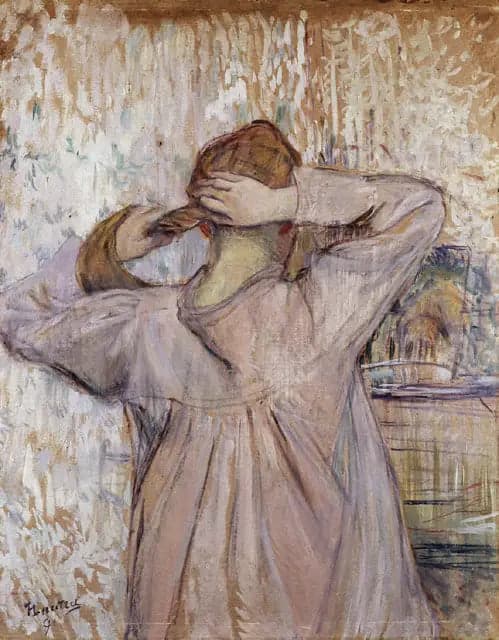
The Toilette - Henri de Toulouse
- Original dimensions
- 540 x 670 cm
- Museum
- Musée d'Orsay
- Year
- 1889
Scene depicted
This painting evokes an iconic life scene, where a woman, naked and vulnerable, prepares for the day. The painting, by revealing her intimacy, creates a dialogue between art and the scene, cataloging the beauty of everyday gestures. The canvas reveals daily life in a new light, transforming banality into a pictorial work imbued with poetry.
Historical context
Created in 1889 in Paris, at the heart of the Belle Époque, The Toilet stands out as a masterpiece of the post-impressionist movement, an artistic current that flourished during a period of great cultural effervescence. The painting resides today in the Musée d'Orsay, testifying to the legacy of its time, where vibrant and colorful Parisian life is celebrated.
Place in the artist's career
The Toilet fits into a key period of the artist's career, representing a peak of his creativity. At this time, Toulouse-Lautrec was achieving success after success, notably with The Moulin Rouge and Les Folies Bergères , revealing the richness of his style and his genius in capturing the essence of Parisian life with a unique and striking approach.
Anecdote
Henri de Toulouse-Lautrec is said to have remarked: "The beauty of life lies in its simplicity and vulnerability." Inspired by scenes of daily life in the cabarets and salons of Paris, The Toilet captures this intimate and delicate moment, the emotion of a woman preparing to face the outside world.