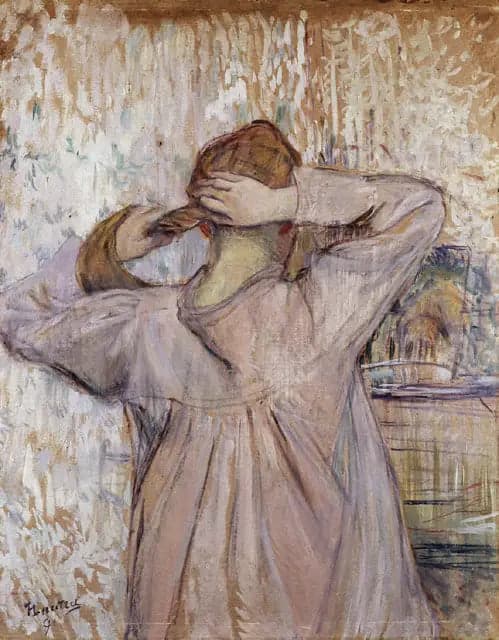
The Toilette - Henri de Toulouse
- Original dimensions
- 46 x 58 cm
- Museum
- Ashmolean Museum
- Year
- 1891
Scene depicted
The Toilet depicts a woman engaged in the intimate daily ritual of a toilette. The scene is imbued with palpable tenderness, where the artist manages to freeze a moment of solitude and beauty, offering a glimpse into the meticulous details, from crumpled sheets to the play of soft light dancing across her features. This canvas evokes an atmosphere of delicacy and calm, like a whisper in a warm room.
Historical context
Created in 1891 in the vibrant city of Oxford, this painting is emblematic of the post-impressionist movement, where artists seek to capture fleeting moments of modern life. The canvas is set against a backdrop of artistic transition, where Toulouse-Lautrec, influenced by Parisian nightlife, settles into a tradition while infusing it with a touch of modernity. The Ashmolean Museum houses this pictorial work that resonates with the hearts of art enthusiasts, measuring 46 by 58 centimeters.
Place in the artist's career
The Toilet occupies a pivotal point in Toulouse-Lautrec's career, marking a turn towards a more personal exploration of the human condition. Compared to his canvases like The Folies Bergère and Dance at the Moulin Rouge, this painting reveals an increased sensitivity to moments of tenderness, juxtaposed with his tumultuous scenes, showcasing the range of his artistic talent.
Anecdote
“Building a painting is like capturing the soul of a moment,” said Toulouse-Lautrec, often recalling his inspirations while wandering through the lively neighborhoods of Montmartre. One spring morning, as he observed a woman preparing in her room, he was struck by the intimacy and delicacy of the moment, thus dedicating to this everyday scene an emotional power in the canvas that still touches us today.