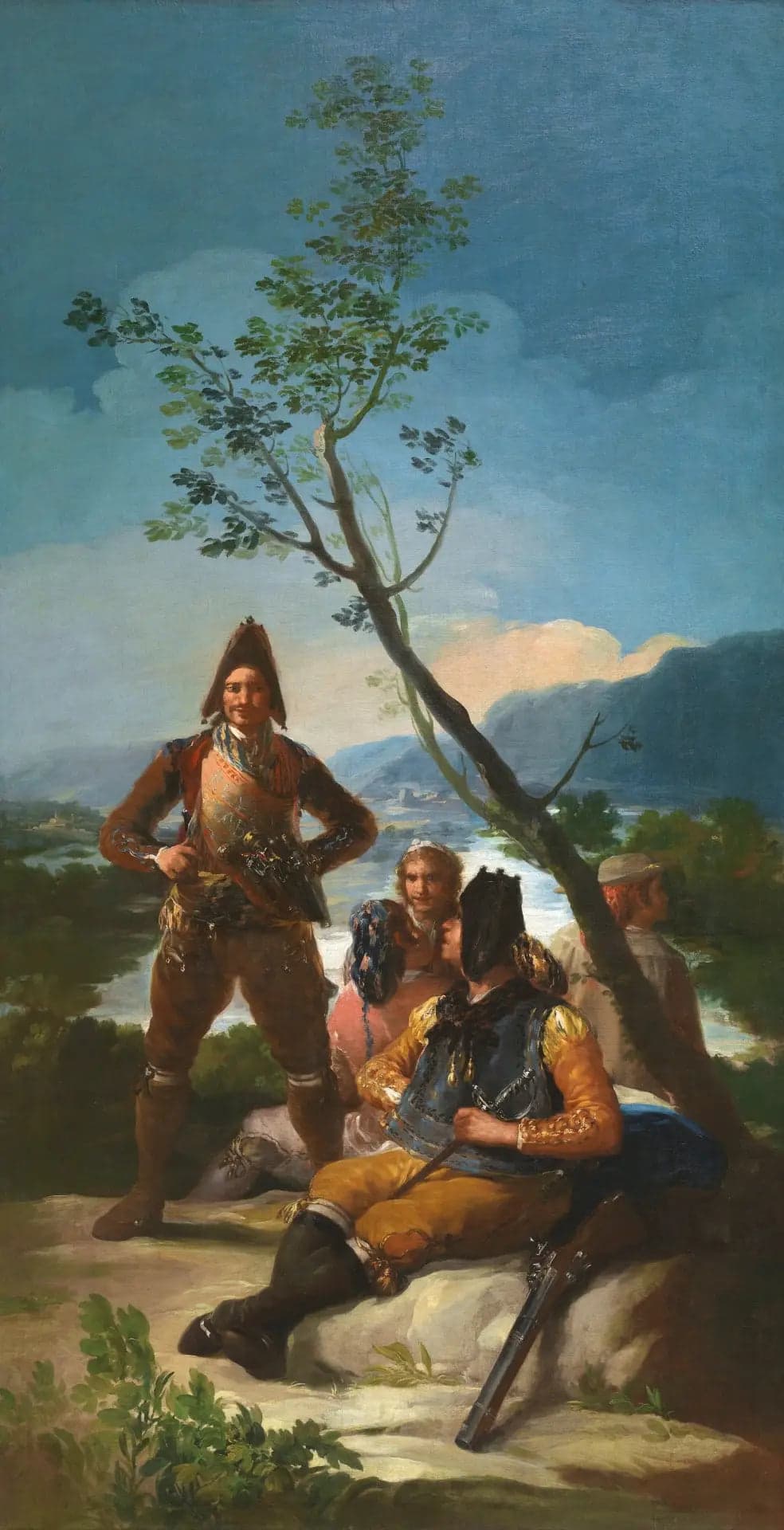
The Tobacco Reserve
- Original dimensions
- 137 x 262 cm
- Museum
- Prado Museum
- Year
- 1779
Scene depicted
This painting depicts a scene of great conviviality around the precious substance that tobacco represented at the time. Human figures are seen gathered, seeking to access this element of consumption. The exchanges, the movement of bodies, and the silences laden with anticipation constitute a true metaphor for social relations in the 18th century. The canvas becomes a mirror of society, revealing facets of daily life while harmonizing the tension between the need for connection and the desire for possession.
Historical context
Created in 1779, “The Tobacco Reserve” is an emblematic work of the Spanish romantic movement. Located in Madrid, in the vibrant city of the Prado, this painting is set in a time when Goya infused his work with social critiques while navigating between realism and the imaginary. The painting, of impressive dimensions, is currently housed in the Prado Museum, a treasure of art that hosts this composition of exceptional richness.
Place in the artist's career
“The Tobacco Reserve” stands as a milestone in Goya's career, reflecting his progression towards artistic maturity. This painting can be paralleled with other works, such as “The Struck” and “The Naked Maja,” where the artist explores themes of human life, passion, and suffering. Through these paintings , one perceives a transition towards a more expressive color palette and more intense emotions, marking Goya's unique approach throughout the history of art.
Anecdote
“I paint not only what I see, but also what I feel.” – Francisco de Goya . It was on a gentle spring afternoon, under the golden light filtering through the foliage, that Goya captured the essence of his contemporaries. This inspiration surged as he walked through a quiet alley, crossing faces imbued with stories, narratives. It is this vibrant atmosphere that resonates in every brushstroke of The Tobacco Reserve , a work where each character seems to whisper its own narrative.