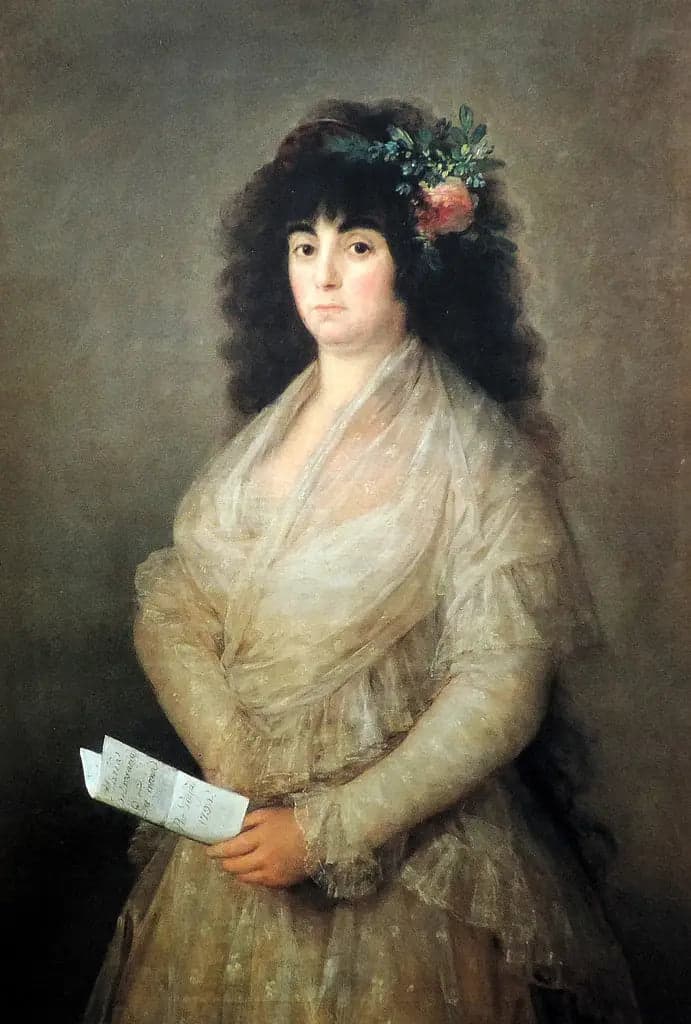
The Tirana
- Original dimensions
- 130 x 206 cm
- Museum
- Royal Academy of Fine Arts of Saint-Ferdinand
- Year
- 1799
Scene depicted
In "La Tirana," Goya depicts an intimate scene, both vibrant and poignant. A centered female figure emanates a captivating power and authority. Her gaze and posture tell a story rich in emotions and internal struggles, symbolizing the strength of women in a patriarchal society. The colors and details offer a deep cognitive impression, inviting the viewer to dive into the thoughts and feelings of the characters.
Historical context
Created at the end of the 18th century, in the heart of Spain, the painting "La Tirana" is part of the emerging artistic movement of romanticism . It is a time of revolutions, both political and cultural, where artists begin to explicitly explore human emotions and popular narratives. In this tumultuous period, Goya delivers a pictorial work that resonates with the passion and complexity of his time. Currently, this canvas resides at the Royal Academy of Fine Arts of Saint-Ferdinand in Madrid, a city steeped in history and creativity.
Place in the artist's career
"La Tirana" marks a turning point in Goya's career, illustrating his shift towards a more emotional and psychological exploration of his subjects. This painting is situated between iconic works such as "The Caprices" and "The Naked Maja," showing a marked evolution both artistically and personally, incorporating elements of realism that directly touch on the human experience.
Anecdote
"My brush is the reflection of my thought," Goya might have said when discussing the genesis of this masterpiece . Imagine a gentle spring morning: the first rays of sunlight filter through the streets of Madrid, bringing a golden light that dances on the faces of the people. It is in this vibrant setting that the artist draws inspiration and captures the essence of the characters that will populate his painting .