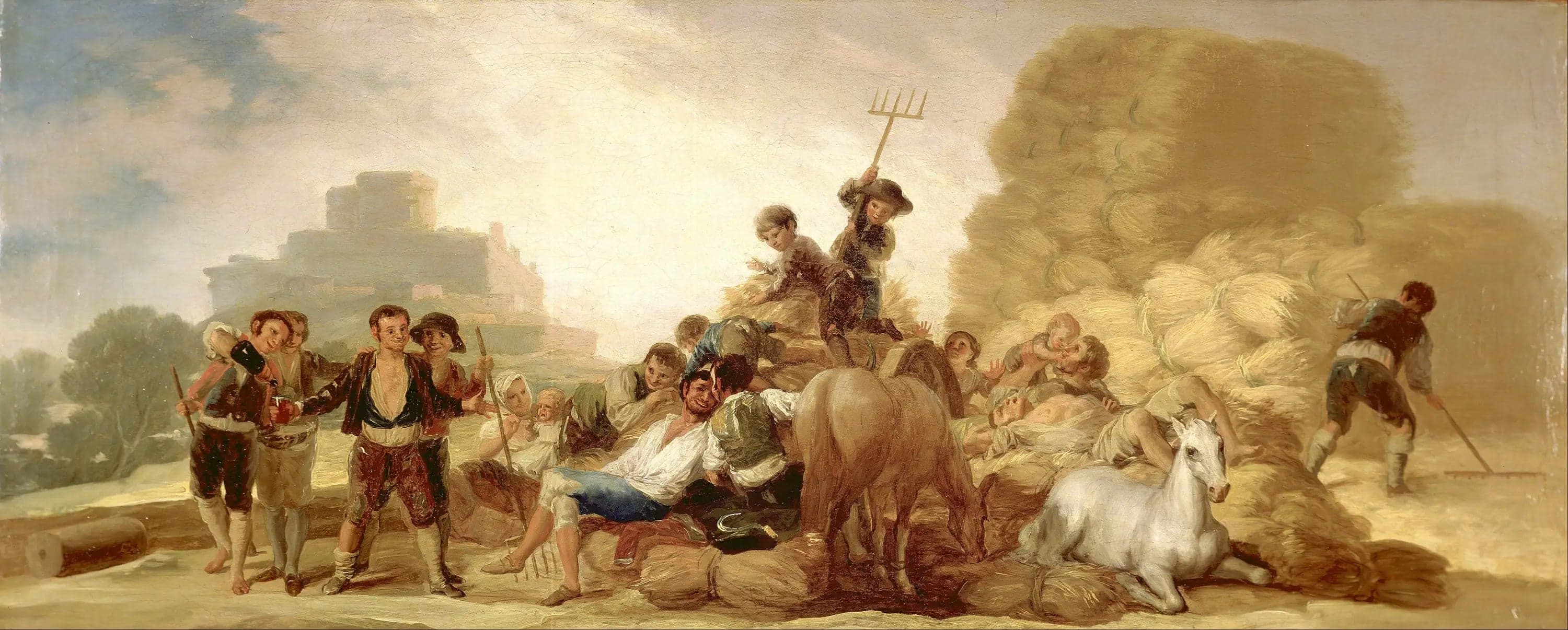
The Threshing Floor
- Original dimensions
- 76 x 34 cm
- Movement
- Rococo
- Museum
- Lazaro Galdiano Museum, Madrid
- Year
- 1786
Scene depicted
This canvas shows a lively scene of the Spanish countryside, where one can see peasants threshing wheat. The characters blend with the dance of sheaves of straw, symbolizing the fertility of the land. The execution of the painting explores the simplicity and beauty of rural work, transforming an ordinary moment into a memorable pictorial work where every detail matters.
Historical context
Created in 1786, this painting emblematic of Francisco de Goya fits into the rich tradition of Rococo. It finds its origin in a historical context where Spain subtly unveiled rural art, highlighting the agrarian traditions of the region. This canvas , now displayed at the Lazaro Galdiano Museum in Madrid, measures 76 x 34 cm, capturing with rare delicacy the essence of scenes from daily life.
Place in the artist's career
Situated at a turning point in his career, The Threshing Floor bears witness to Goya's artistic maturation. Alongside works such as The Naked Maja and The Caprices , he demonstrates a progressive mastery of a pictorial language that blends reality and emotion. This canvas reflects a deep empathy for the people, a characteristic that would become his signature.
Anecdote
Goya once declared: “Every scene of life is a painting more than the painting itself.” It was while wandering in the fields at dawn, feeling the dew on his feet, that the artist found inspiration for this masterpiece . The evocative power of The Threshing Floor perfectly illustrates this communion between man and nature.