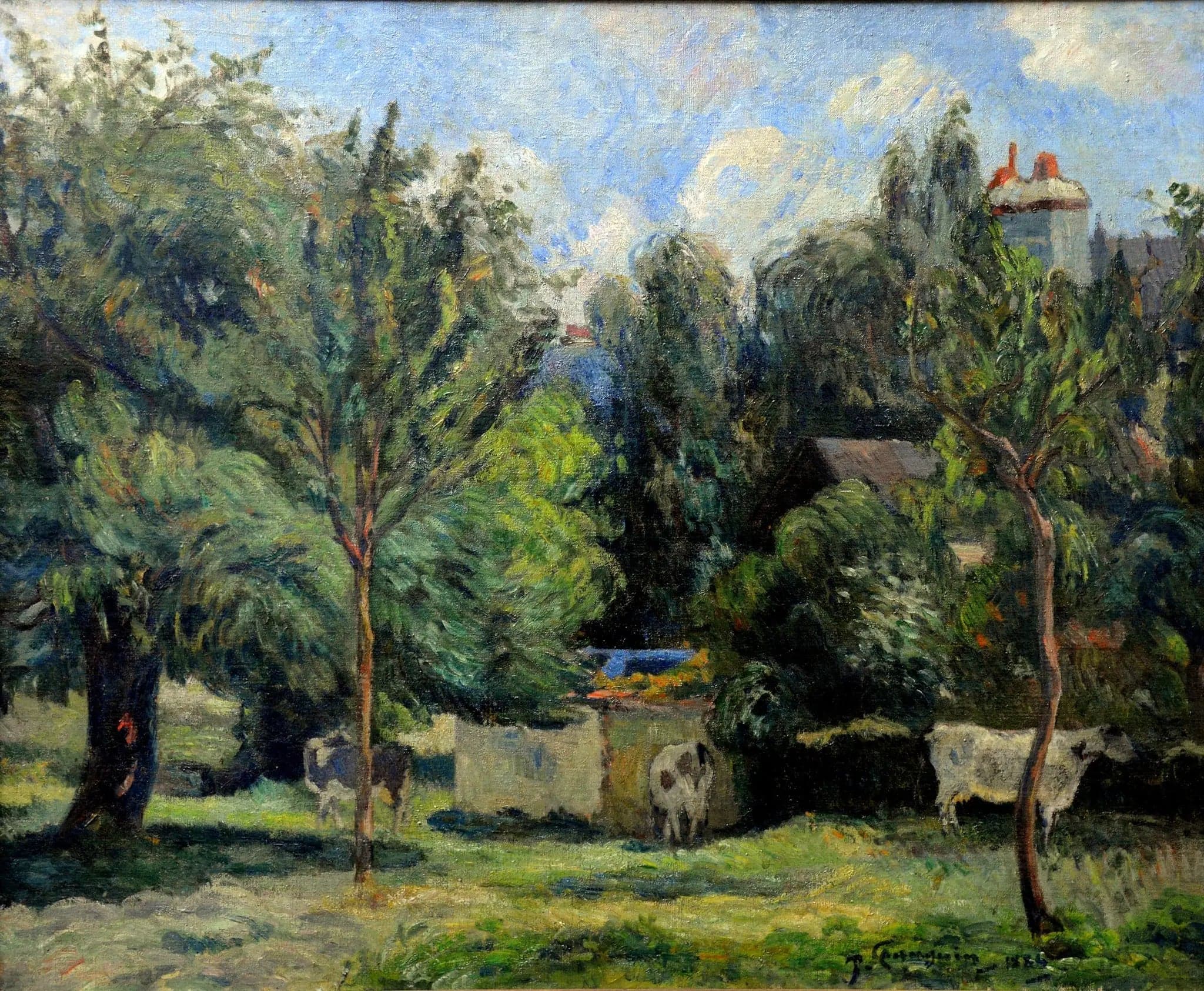
The Three Cows
- Original dimensions
- 73 x 60 cm
- Museum
- building of the Fine Arts Museum of Winterthur
- Year
- 1884
Scene depicted
In this painting, Paul Gauguin captures the serenity of a pastoral scene. The cows grazing peacefully in a green field evoke a simple and authentic harmony, revealing a moment of peace and contemplation. The vibrant colors and rounded shapes of the animals communicate an unmatched softness and tranquility. Gauguin succeeds in transcribing the beauty of mundane moments in the countryside, inviting the observer to dive into this soothing rural universe.
Historical context
Created in 1884 in the historic city of Paris, this work belongs to the post-impressionist movement, known for the liberation of colors and the search for personal expression. The Three Cows evokes a time when art was taking flight towards new explorations, moving away from the realism s of the past. Today, this painting is carefully preserved at the Fine Arts Museum of Winterthur , dimensions 73 x 60 cm, testifying to Gauguin's legacy and his unique artistic sensitivity.
Place in the artist's career
The Three Cows is situated at a turning point in the career of Paul Gauguin , marking his establishment as a bold and innovative artist. This canvas, foreshadowing later works such as The Vision After the Sermon and Where Did We Come From? What Are We? Where Are We Going?, shows the evolution of his contribution to art, both in technique and expression. His ability to combine color and emotion reaches a peak here, testifying to his unique artistic journey.
Anecdote
“Let your mind wander in the landscape, and the painting will follow,” Gauguin once said, while contemplating a bucolic scene. It was during a quiet morning, amidst the lush nature, that the artist drew inspiration to create The Three Cows. The fresh air carried with it the scents of the damp earth, while the first rays of sunlight illuminated the blank canvas, gradually revealing the evocative power of this pictorial work.