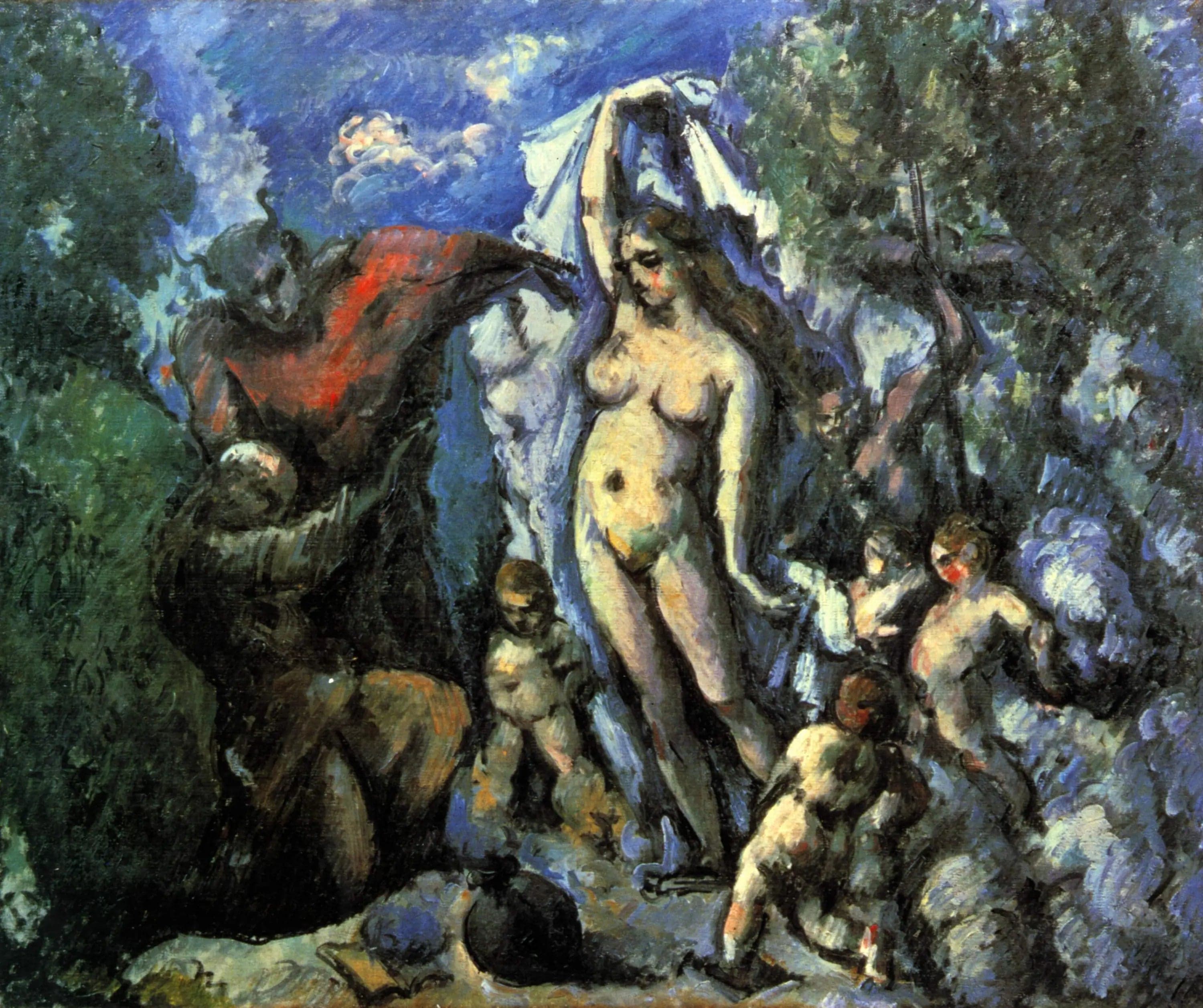
The Temptation of Saint Anthony
- Original dimensions
- 56 x 47 cm
- Museum
- Orsay Museum
- Year
- 1877
Scene depicted
This painting expresses the spiritual struggle of Saint Anthony against demonic visions, symbolizing the inner conflicts of humanity. The representation of this saint lost in a troubled environment evokes the anguish of the choice between flesh and spirit. The human forms, notably the ghostly figures surrounding him, blend with a surreal decor, immersing the viewer in a world of despair and temptation.
Historical context
Created in Paris in 1877, during a turning point of the 19th century, The Temptation of Saint Anthony is part of the Post-Impressionism movement, which seeks to express emotion through painting . In this city of art and creativity, Cézanne, one of the precursors of modernity, creates a work that resonates even today. The painting is currently exhibited at the Orsay Museum in Paris, a true temple of pictorial works. Its composition raises an incredible intensity through its dimensions, 56 x 47 cm, where every centimeter tells a story.
Place in the artist's career
The Temptation of Saint Anthony stands as one of Cézanne's first masterpieces, reflecting his evolving style. It can be compared to The Mont Sainte-Victoire and The Garden of the Studio , two works that show his journey towards mastering light and forms. This painting represents a crucial step, where the artist begins to forge his unique style, overflowing with color and texture.
Anecdote
“Painting is a means of expressing the unspeakable,” Cézanne said while evoking the artistic force of his paintings. One morning bathed in light, as he walked through the alleys of the studio, a vision of this inner struggle between good and evil struck him. This personal reminiscence powerfully embodies The Temptation of Saint Anthony , thus carrying the imprint of a spiritual and artistic quest.