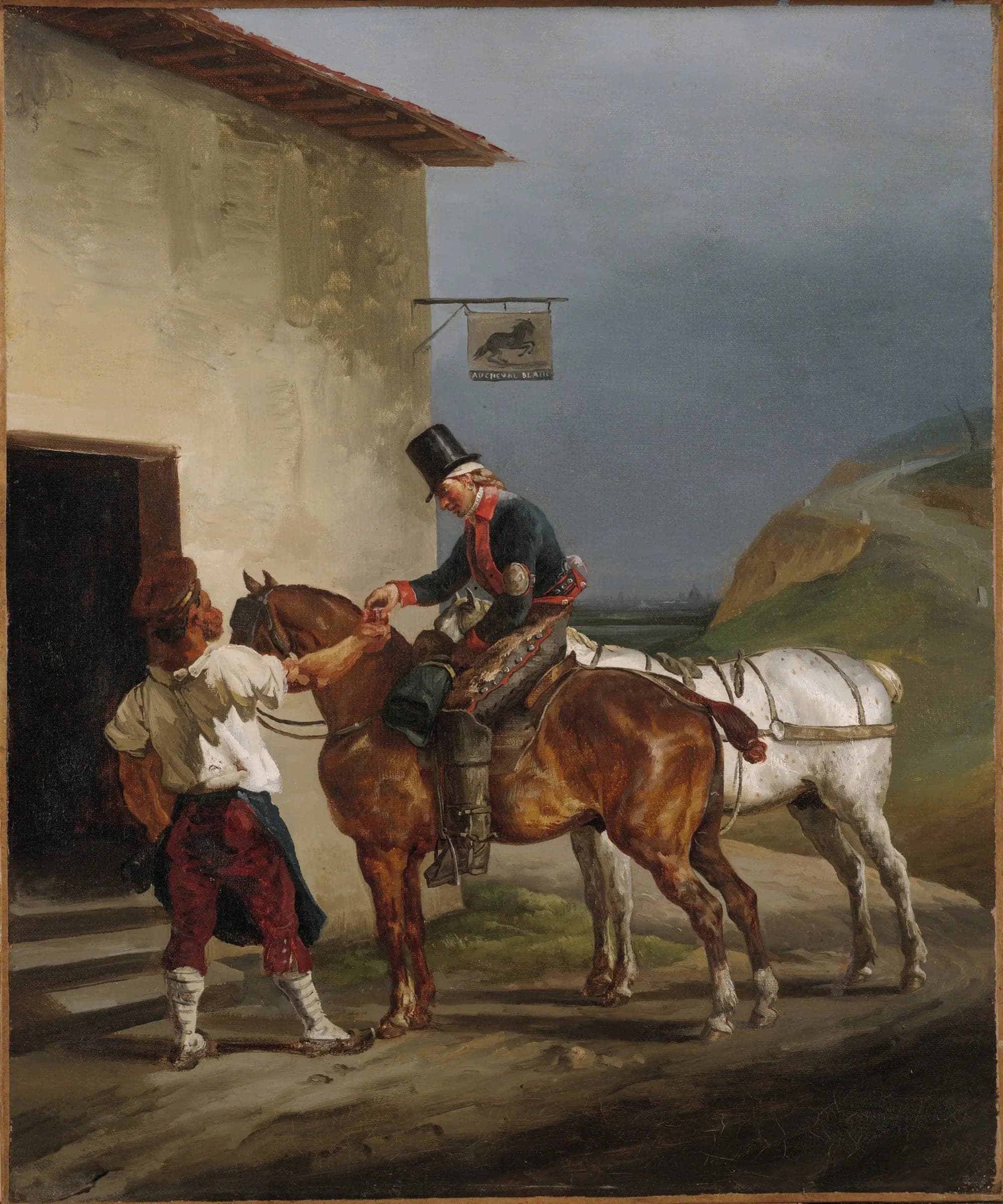
The Tavern of the White Horse
- Original dimensions
- 44.5 x 54 cm
- Museum
- Fogg Art Museum
- Year
- 1821
Scene depicted
This painting represents a lively scene within a tavern, where apparent carefreeness contrasts with the depth of exchanged glances. The characters, likely workers, gather around a drink, sharing stories that narrate the soul of the times. Géricault thus captures a fleeting moment of camaraderie while revealing the melancholy of an era when happiness was simple, yet fragile.
Historical context
Created in 1821, The Tavern of the White Horse is set against a rich historical backdrop, at the crossroads between pictorial tradition and the emergence of romanticism . This iconic painting, currently on display at the Fogg Art Museum , reflects a moment when France was under the influence of profound social and political reforms. Eager to capture the essence of daily life, Géricault, in the heart of Paris, managed to immortalize the atmosphere of taverns. Its dimensions of 44.5 x 54 cm invite contemplation of every detail of this vibrant painting .
Place in the artist's career
The Tavern of the White Horse marks a significant milestone in Géricault's artistic journey. Following notable works such as The Raft of Medusa and The Charging Chasseur , this painting represents a turning point towards a more introspective and emotional exploration of his characters. The richness of its composition and its nuances of feeling testify to a palpable evolution in his style, a step towards an artistic maturity clamoring for humanity and truth.
Anecdote
Géricault once whispered: “I seek the truth in shadow and light; it is in this play that emotion is forged.” Thus, one sunny morning, wandering the Parisian streets, he encountered a face marked by life, an inspiration that became the starting point of his canvas . It is this quest for simplicity and authenticity, a reflection of human nature, that permeates every brushstroke in The Tavern of the White Horse.