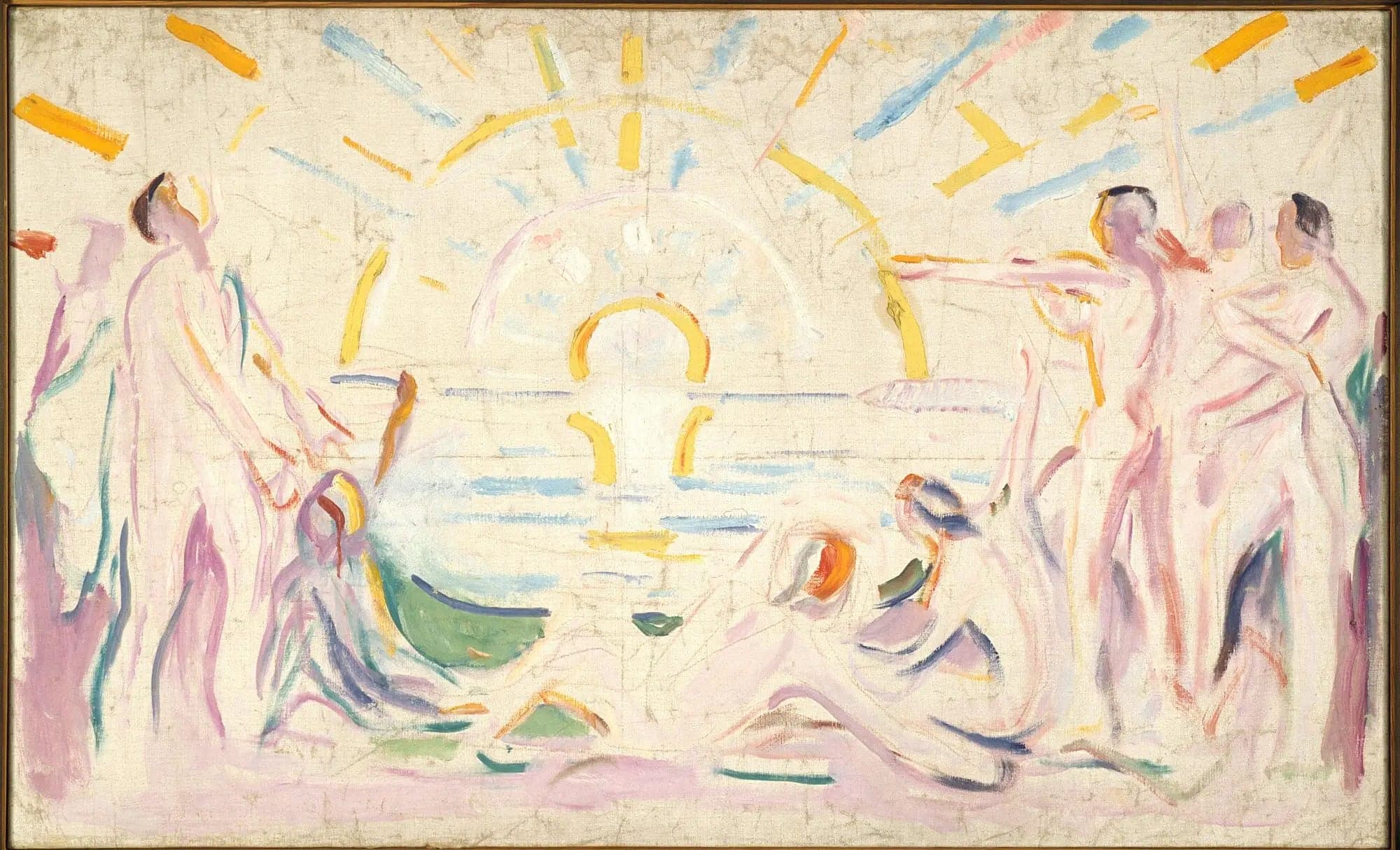
The Sun and the Awakening of Naked Men
- Original dimensions
- 115.5 x 70 cm
- Museum
- Munch Museum
- Year
- 1910
Scene depicted
The painting “The Sun and the Awakening of Naked Men” depicts humanity in harmony with nature, where naked figures emerge from an enigmatic landscape under the first rays of the sun. This composition, imbued with light, explores the indissoluble link between the human body and its environment, while celebrating the rebirth and awakening of the senses in contact with nature.
Historical context
Created in 1910, this painting emblematic of Edvard Munch exemplifies the expressionist movement, rooted in a flourishing cultural context in Oslo, Norway. The canvas , now displayed at the Munch Museum, captures the essence of an era when artists sought to express the unspeakable through their pictorial works. In this historical context, Munch, influenced by the torments and passions of his time, brings to life an evocative scene, frozen in poignant beauty, measuring 115.5 by 70 cm.
Place in the artist's career
This masterpiece is part of a pivotal period in Munch's artistic career, marked by expressive maturity. When compared to “The Night” and “The Scream,” one perceives an evolution in his style, blending bold technique with emotional depth, making the canvas even more striking.
Anecdote
“The morning light seizes my heart and my thoughts, like a sweet awakening,” said Munch in one of his reflections. He stood on the shore, inspired by the gentleness of a spring morning, where nature awakens the senses and reactivates passions. This canvas , revealing the cycle of life and nature, evokes this original emotion with an intensity that still haunts the viewer.