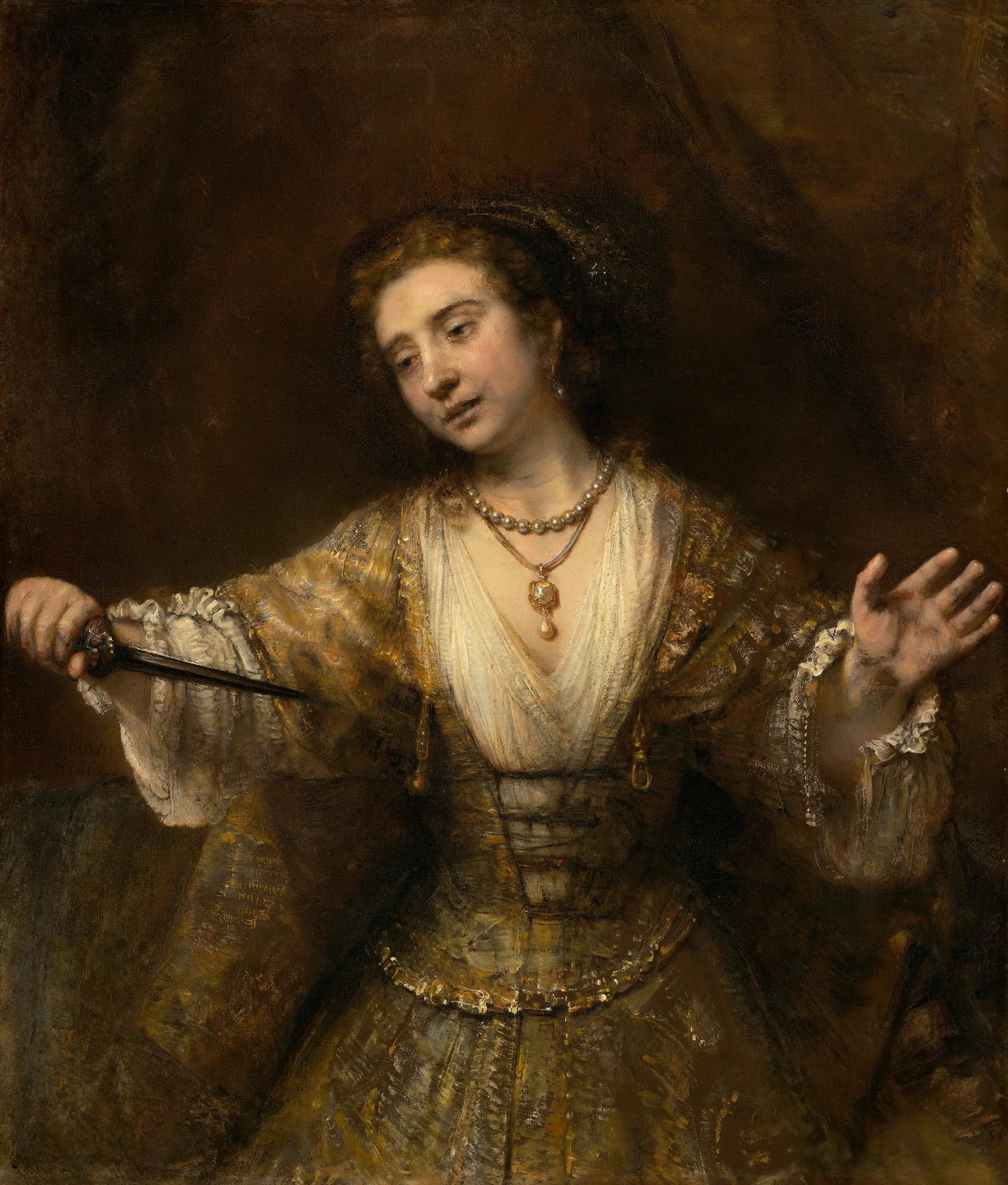
The Suicide of Lucretia
- Original dimensions
- 101 x 120 cm
- Movement
- Dutch Golden Age
- Museum
- National Gallery of Art
- Year
- 1664
Scene depicted
“The Suicide of Lucretia” depicts the poignant moment when Lucretia, after suffering the affront of an assault, chooses death to preserve her honor. The scene is imbued with drama and sadness. Rembrandt manages to capture the inner turmoil and determination of the protagonist, offering a striking vision of despair while celebrating the tragic beauty of her sacrifice.
Historical context
Created in 1664, this painting is emblematic of a time when Dutch art reached its peak. Rembrandt , based in Amsterdam, immerses us in a universe where light and shadow intertwine, revealing the very essence of human emotion. Today, this precious canvas rests at the National Gallery of Art in Washington, bearing witness to the indelible artistic legacy of its creator.
Place in the artist's career
This canvas is a milestone in Rembrandt 's career, illustrating his mastery of complex emotions. Following remarkable works such as “The Night Watch” and “The Anatomy Lesson of Dr. Nicolaes Tulp,” “The Suicide of Lucretia” is situated at a period of artistic maturity where Rembrandt 's brush reveals deeper emotions, sculpted by his years of experience.
Anecdote
“Art must touch the soul.” This mantra resonates deeply in the creation of this masterpiece . In 1664, on a cool morning, as soft light filtered through the clouds, Rembrandt drew inspiration from a tragic legend, bringing Lucretia to life with an evocative touch. Each brushstroke evokes this melancholy, weaving a connection between the heart of the artist and the soul of the work.
Major exhibitions
Late Rembrandt