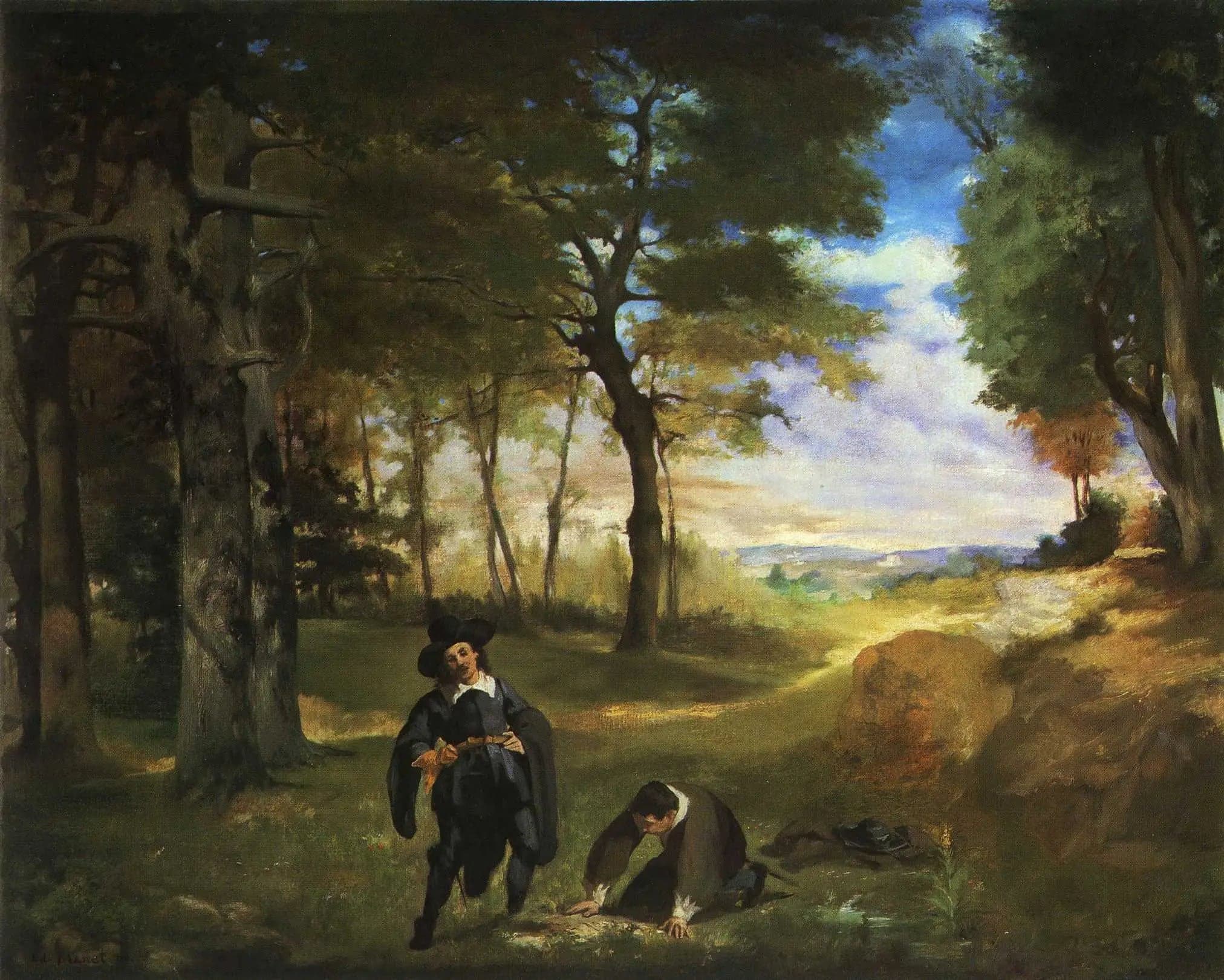
The Students of Salamanca
- Original dimensions
- 92.6 x 72.7 cm
- Museum
- Pola Museum
- Year
- 1860
Scene depicted
The painting “The Students of Salamanca” depicts a vibrant scene of academic life, where young men stand out through their intellectual engagement. The atmosphere is imbued with a vibe that is both studious and relaxed, reflecting the dynamic of a place of knowledge, where laughter and passionate discussions resonate under an enchanting sky. The meticulous details reveal not only the unity of this group but also the cultural richness of their environment.
Historical context
Created in 1860, this painting is emblematic of the realist movement, set against the stimulating cultural and artistic backdrop of Paris. Édouard Manet , a central figure in modern art, explores here the themes of student life in Salamanca, Spain. The canvas remains today a centerpiece of the Pola Museum , attracting the admiring gazes of visitors eager to discover this unique pictorial work.
Place in the artist's career
“The Students of Salamanca” represents a crucial step in Manet's career, demonstrating his technical skill in contrast to earlier works like “Luncheon on the Grass” and “Olympia.” This painting illustrates his transition to stylistic maturity while foreshadowing his innovations in the treatment of light and color.
Anecdote
According to Manet, the creative process of a painting is often nourished by unexpected moments: “Beauty is everywhere, you just have to open your eyes.” One spring morning, while wandering the streets of Salamanca, he was captivated by students engrossed in their studies under the sun. This fleeting vision gave birth to the painting that strikingly captures youth and scholarship.