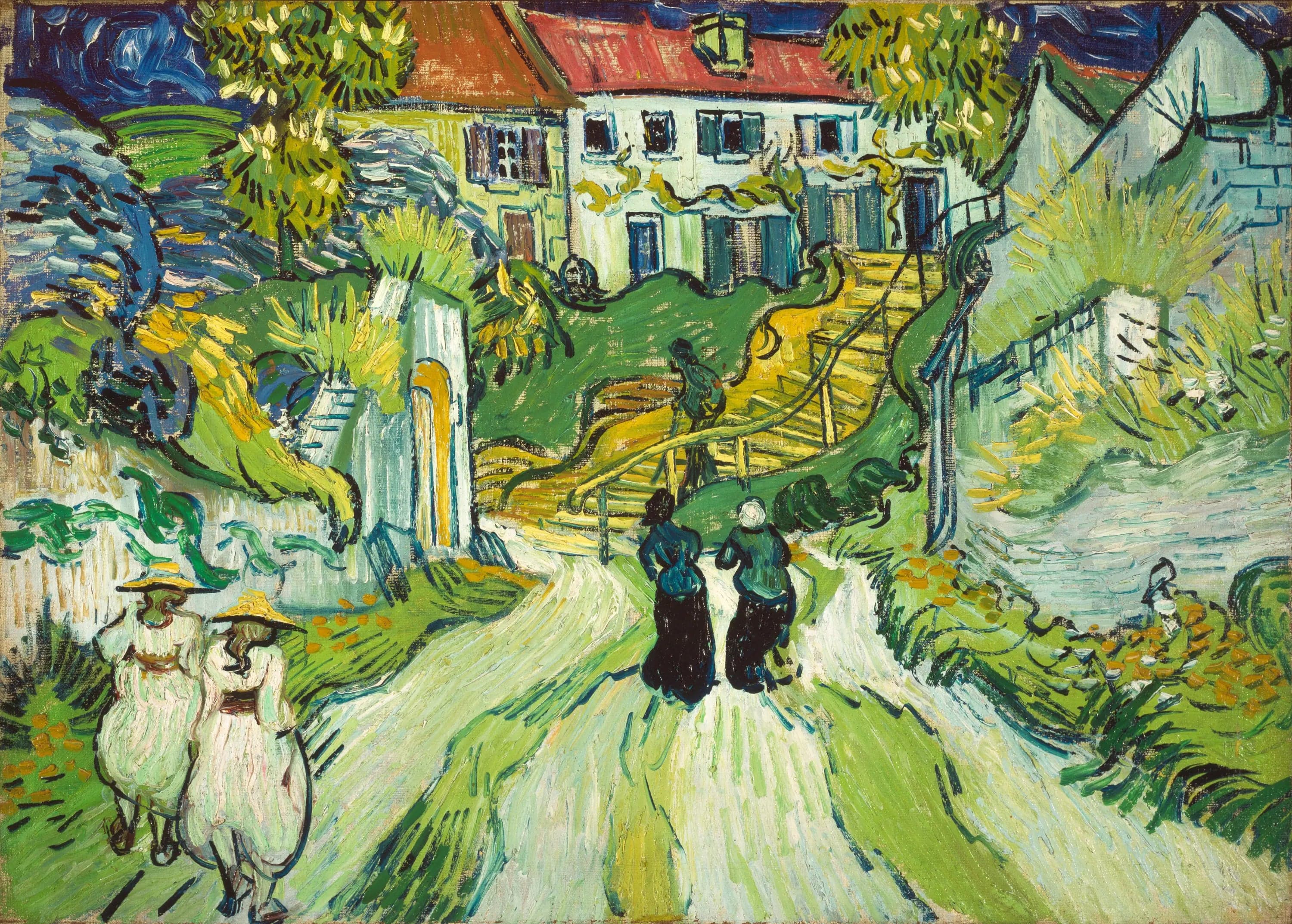
The Stairs at Auvers
Scene depicted
The painting “The Stairs of Auvers - Vincent van Gogh ” captures a moment of transition, where the steps rise in spirals, symbolizing both the ascent and descent of the creative spirit. The vibrant colors and dynamic brushstrokes immerse the viewer in the intensity of the emotions conveyed by these iconic places.
Historical context
Created in 1890, this painting emblematic finds its roots in Auvers-sur-Oise , a place dear to Vincent van Gogh , at the heart of the post-impressionist movement. The painting is currently exhibited at the Saint Louis Art Museum , measuring 70.5 x 50 cm, reflecting the artist's inner struggles and his quest for light.
Place in the artist's career
This painting fits into a pivotal period of the artist, marking his stylistic peak. When compared to “ The Starry Night ” and “ The Sunflowers ”, one perceives an evolution in the handling of colors and emotions, where each creation seems to resonate like a silent cry of the soul.
Anecdote
“I want to give a soul to my works,” said the artist. The inspiration behind this masterpiece was born one morning when Vincent walked up the steps of an old building, absorbing the serenity of the place, where each step resonated with his melancholy. The Stairs of Auvers then becomes a reflection of his tormented soul.