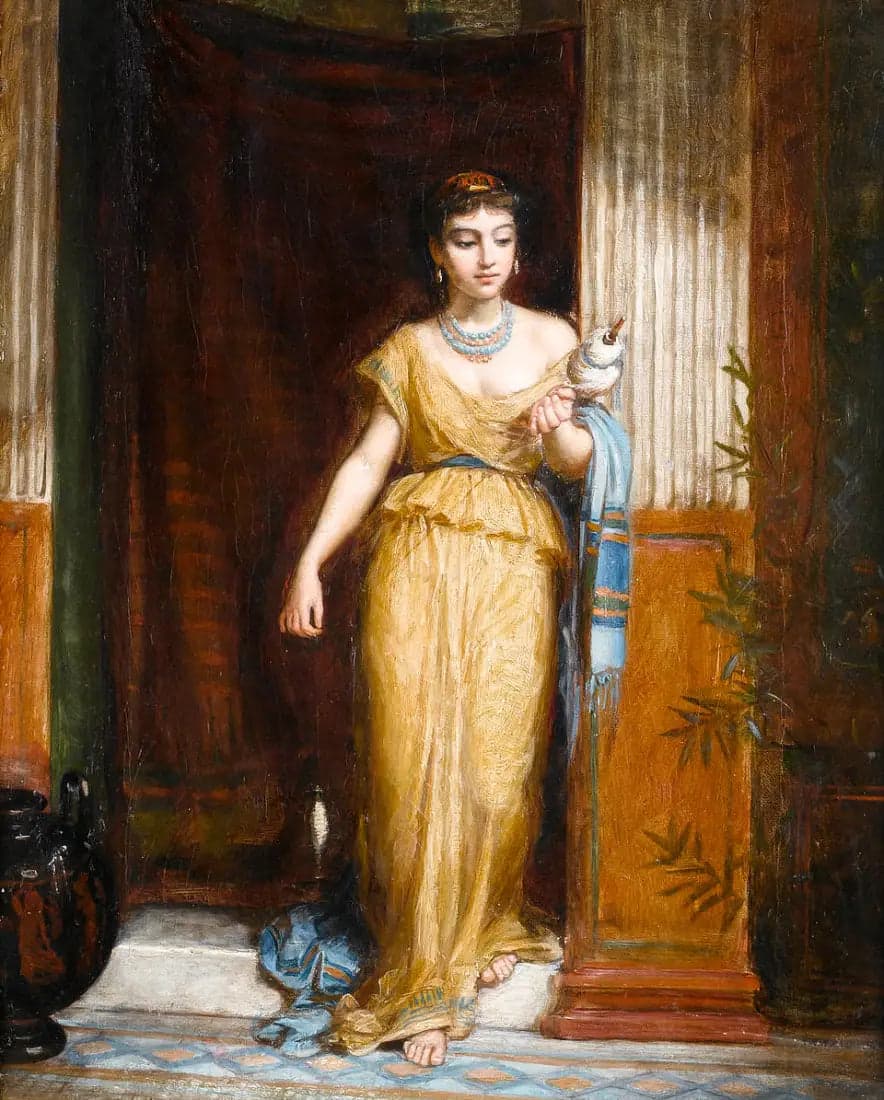
The Spinner
Scene depicted
In this captivating painting, Waterhouse depicts a young woman absorbed in the act of spinning, embodying the grace and delicacy of everyday life. The composition reveals a scene rich in symbolism , both tactile and emotional, where the light subtly caresses the contours of the spinner's face, creating a warm and intimate atmosphere.
Historical context
Created in 1890, the painting "The Spinner" is an emblematic work of John William Waterhouse , a major artist of the Pre-Raphaelite movement. This canvas was born in London, a vibrant city, rooted in a time of cultural and artistic renewal. Currently, the painting is preserved in the collection of the Gallery Oldham, in Lancashire, and measures 95.25 x 200.66 cm.
Place in the artist's career
"The Spinner" fits into Waterhouse's mature period, where he mastered the fusion of classical forms and modern themes. This masterpiece is a high point that harmoniously dialogues with "The Nymph and The Wolf" and "Ophelia," allowing us to observe the evolution of his mastery of light and the profound humanity of his characters.
Anecdote
John William Waterhouse once stated: "Art is the echo of a life, a silent melody observed by those who seek to understand." This masterpiece was inspired by the soft whispers of a sunny morning, as he wandered through a blooming garden, the scents of colorful flowers floating in the air. He captured this ephemeral beauty in the evocative power of his painting .