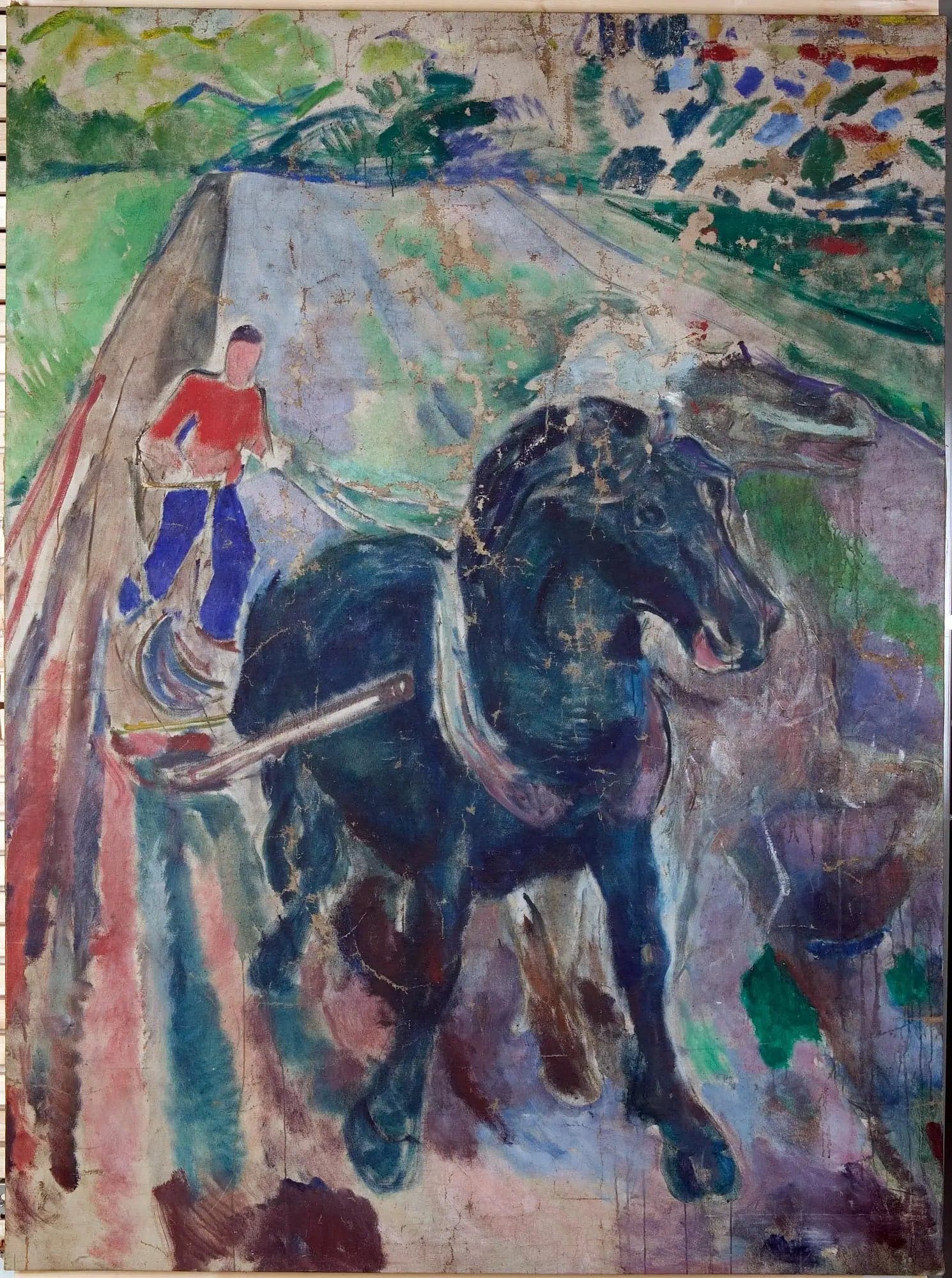
The Sower
- Original dimensions
- 186 x 249 cm
- Museum
- Munch Museum
- Year
- 1916
Scene depicted
The painting illustrates a worker, a sower, moving his gesture with determination in the heart of a golden field. His body, marked by strength and fatigue, stands out against a horizon saturated with light, while vibrant colors diffuse a poignant emotion across the canvas . It is an ode to labor, to the nurturing earth, where each seed sown becomes a symbol of hope, renewal, and life.
Historical context
Created in 1916 in Oslo, this canvas is imbued with the breath of the expressionist movement, revealing a vibrant yet troubled era. Edvard Munch , an iconic figure of this movement, manages to capture the essence of humanity in search of meaning in a changing world. The painting is currently displayed at the Munch Museum, which honors the legacy of this uniquely talented artist, measuring 186 x 249 cm.
Place in the artist's career
The Sower fits into the artistic maturity of Edvard Munch . This painting, while emblematic of his style, can be paralleled with The Scream and The Madonna , revealing both a technical and emotional evolution in his approach to humanity in the face of nature and its inner struggles.
Anecdote
“It is not just about painting, but about awakening souls.” A phrase that perfectly summarizes the essence of Munch. Inspired by the sad landscapes of a winter morning, while a gentle breeze embraced the earth, he sketched the idea of The Sower . This painting resonates with hope, while capturing the melancholy of agricultural labor, connecting the past and the future.