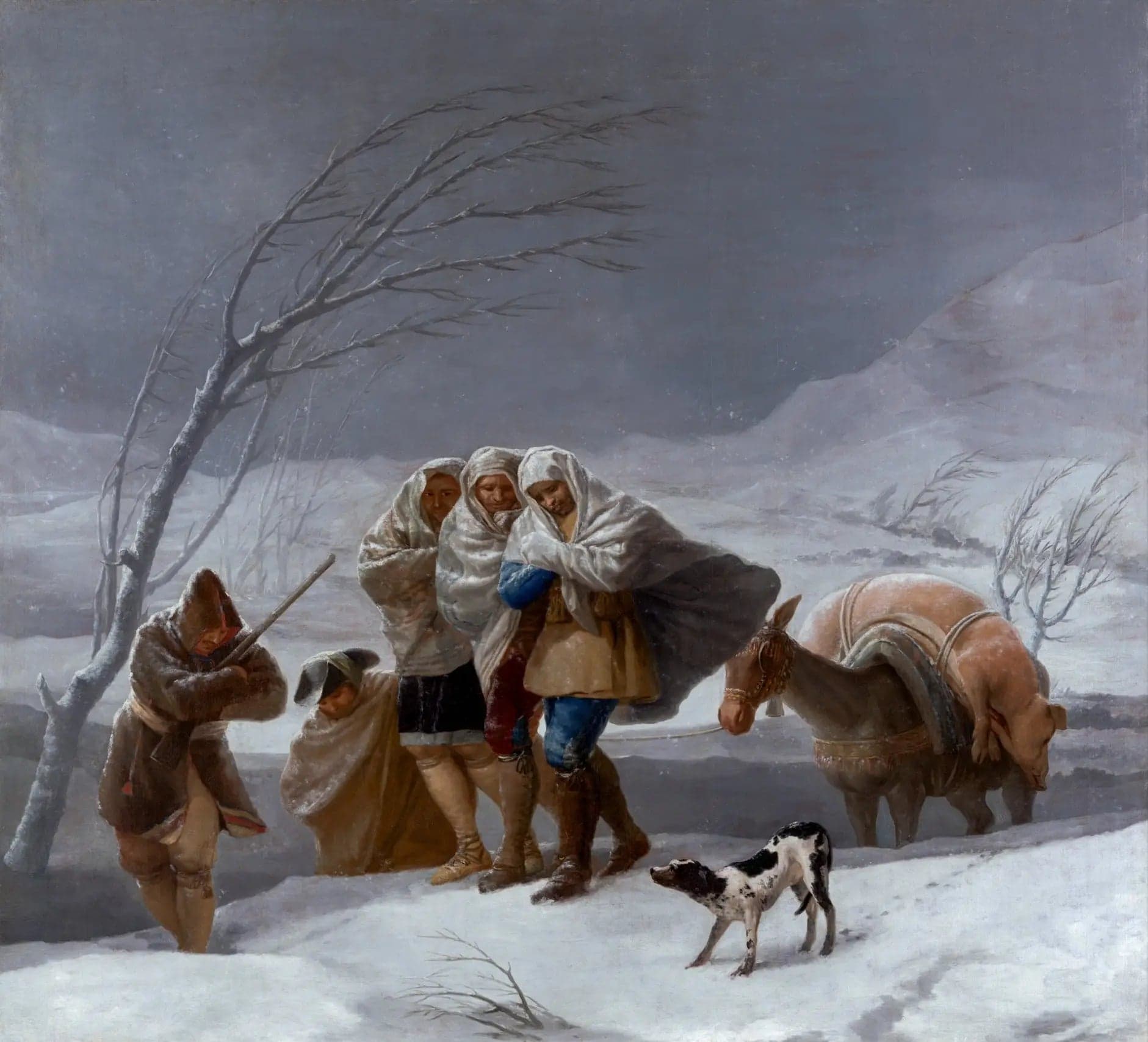
The Snow
- Original dimensions
- 293 x 275 cm
- Movement
- romanticism
- Museum
- Prado Museum
- Year
- 1787
Scene depicted
The painting “The Snow” depicts a winter landscape of rare beauty. Snowflakes fall slowly, covering the ground with a brilliant purity. In this painting, human silhouettes move cautiously through the snow, taking careful steps in the serene vastness. This contrast between human fragility and the powerful forces of nature is beautifully represented, illustrating a central theme of romanticism : the humility of man in the face of the grandeur of the universe.
Historical context
Created in 1787, in Madrid, where Spanish art emerges in a remarkable era of transformation, The Snow deeply reflects the romantic sensibility of Francisco de Goya . This painting , majestically displayed at the Prado Museum, embodies a period where emotion begins to take precedence over rationalism, with its impressive dimensions captivating the gaze and the mind.
Place in the artist's career
The Snow stands as a foundational pivot in Goya's career, illustrating his transition towards more introspective and emotional concerns. Alongside other paintings like The Executions of May 3rd and The Family of Charles IV , it demonstrates a growing mastery of emotional expression, thus consolidating his role as a pioneer of romanticism in Spain.
Anecdote
“The beauty of the snow reminds me of the tears of men.” This thought suggests Goya's state of mind at the time of creating this work , when an unexpected snowstorm led him to contemplate nature in a sincere and powerful light. His creative spirit found refuge in the soothing silence of this landscape, translating the very essence of this emotional experience onto his canvas .