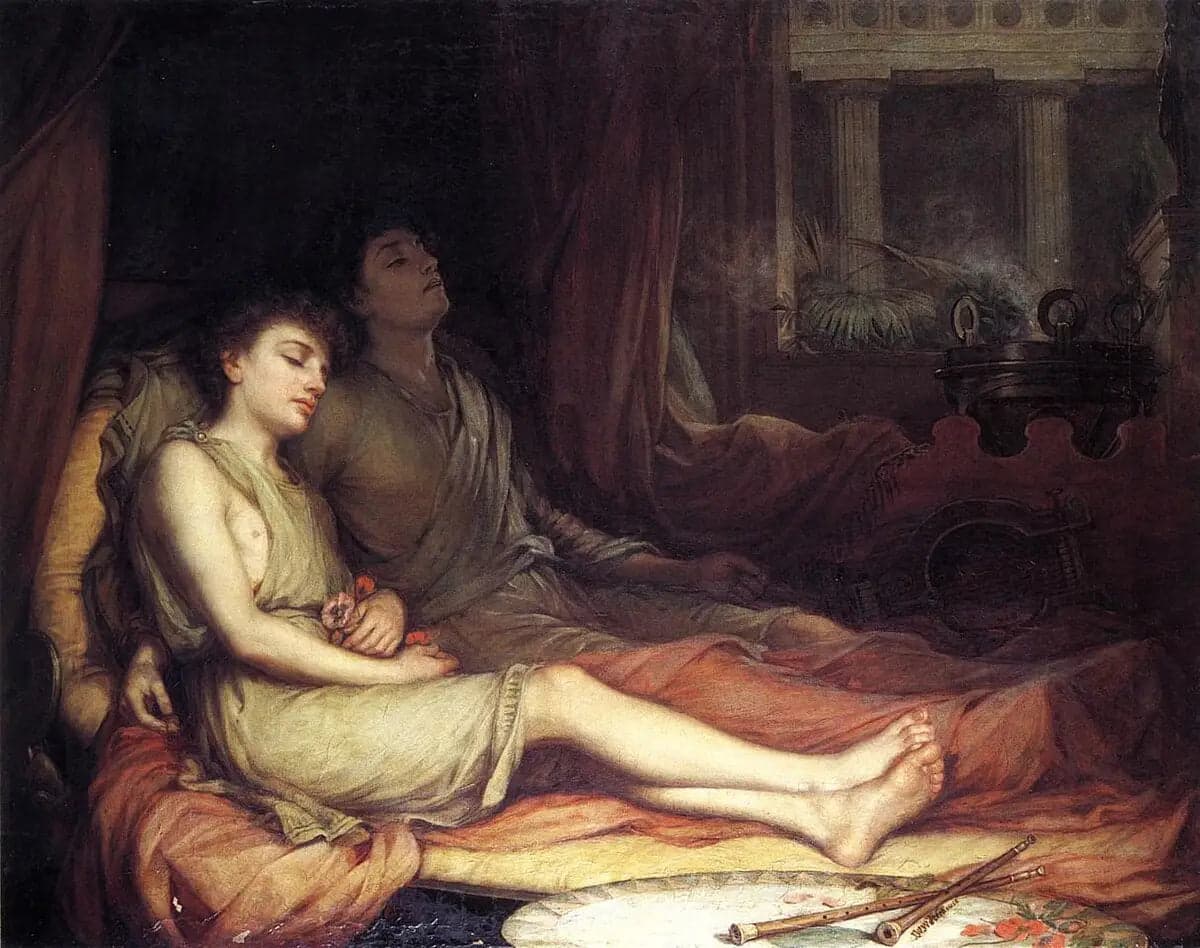
The Sleep and Death of His Half-Brother
Scene depicted
This pictorial work depicts a poignant scene where sleep unites with death against a backdrop of a mystical atmosphere. The main model, a face of troubled sweetness, evokes the fragility and ephemeral beauty of human existence, while the light plays on the delicate drapery, creating a striking contrast between life and absence.
Historical context
Created in 1874, the painting emblematic The Sleep and His Half-Brother is part of the Pre-Raphaelite movement in London, England. At that time, the artistic movement aimed to rediscover beauty and innocence. Today, this canvas is preserved at the Tate Britain in London, testifying to a time when art merges with poetic storytelling, measuring approximately 180 x 108 cm.
Place in the artist's career
The Sleep and His Half-Brother marks a turning point in Waterhouse's career, symbolizing his mature and refined style. Alongside other paintings such as Ophelia and Ulysses and the Sirens , this painting resonates with the thread of soothing light, where the complexity of human emotions intertwines with nature. It is a masterpiece that illustrates his transition from a post- Impressionist study to a more narratively complex expression.
Anecdote
John William Waterhouse once stated, regarding his creative process: "Every masterpiece is like a dream that one seeks to materialize." Thus, on a sweet spring morning, while wandering in the gardens of Kensington Palace, the idea of The Sleep and His Half-Brother came to him, inspired by the whisper of flowers and the song of birds, a primal force that dances in every brushstroke of this painting .