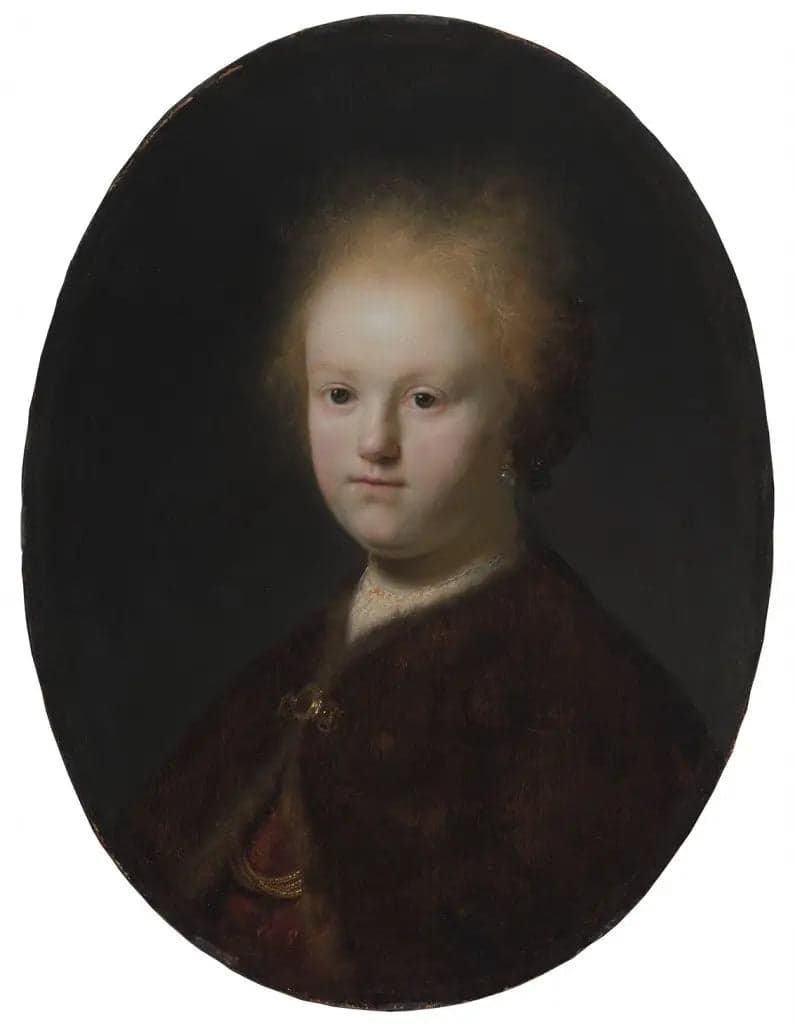
The Sister of Rembrandt, or Portrait of a Young Girl
- Original dimensions
- 45.7 x 58.4 cm
- Museum
- Virginia Museum of Fine Arts
- Year
- 1632
Scene depicted
In this canvas, Rembrandt depicts a young girl, illuminated by a soft and enveloping light, capturing the innocence and vulnerability of adolescence. Her face, peaceful, reflects a rich inner life, while the play of shadows enhances her expression. This painting illustrates not only Rembrandt's technical skill but also his deep respect for human psychology and his ability to tell a story through a simple gaze.
Historical context
Created in 1632 in Amsterdam, Rembrandt's Sister, or Portrait of a Young Girl, is part of the golden period of the Baroque movement, where the artist was able to capture the depth of human emotions. The painting is housed in the Virginia Museum of Fine Arts , allowing this artwork to be appreciated by enthusiasts from around the world. Its dimensions, although modest, make the scene extraordinarily intimate.
Place in the artist's career
Rembrandt's Sister, or Portrait of a Young Girl occupies a crucial moment in the artist's career, marking his ascent to the peak of his art. At this time, he perfectly masters light and movement, as evidenced by other notable works such as The Anatomy Lesson of Dr. Tulp and The Night Watch, which reveal his evolution towards a more dramatic and narrative approach.
Anecdote
Rembrandt is said to have declared: “Light and shadow are the best narrators of our souls.” Imagine him, one spring morning, painting in his studio, the smell of oils and pigments floating in the air, each brushstroke breathing life into a beloved face. This original emotion infused in Rembrandt's Sister, or Portrait of a Young Girl, evokes a powerful connection between the artist and his model.