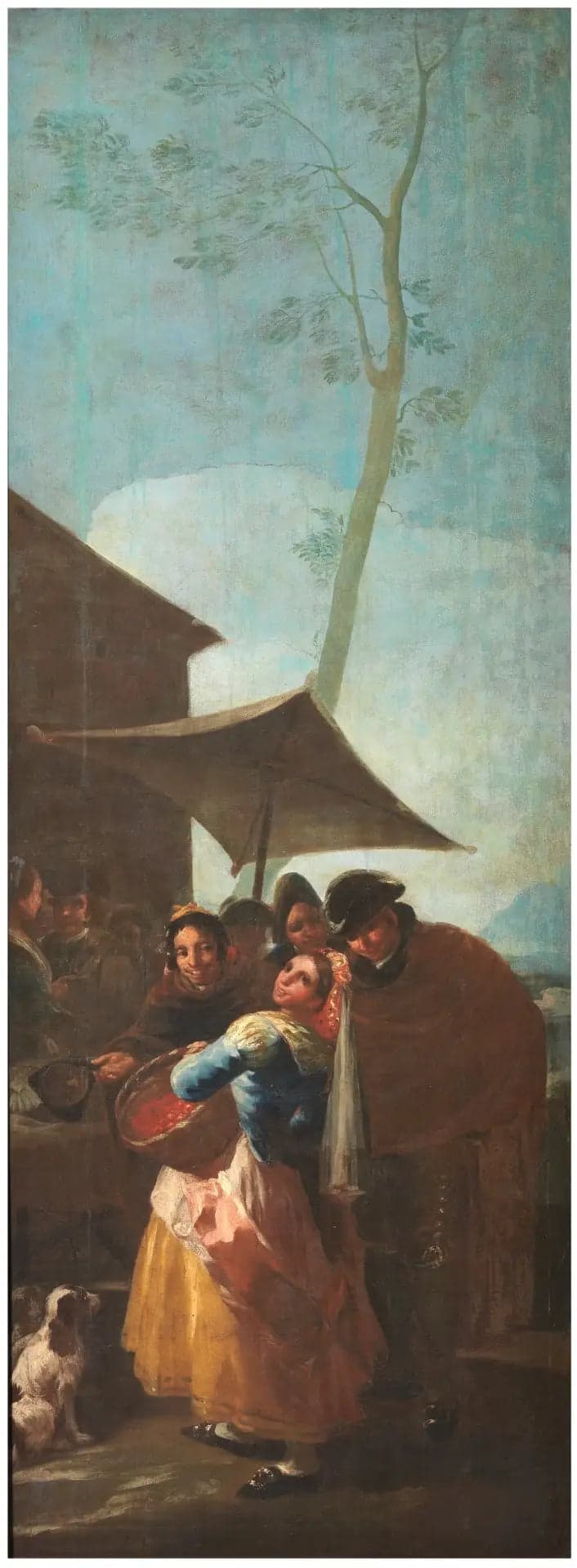
The Seller of Acorns
- Original dimensions
- 100 x 259 cm
- Museum
- Prado Museum, Madrid, Spain
- Year
- 1778
Scene depicted
The Seller of Medlar immerses us in a typically Spanish scene, where a traditional woman offers medlar fruits, prized fruits, under the curious gaze of passersby. This canvas is not limited to a simple display; it tells a story, evokes the scents of ripe fruits and the murmurs of the market, inviting the viewer to share this unique sensory experience.
Historical context
Created in 1778, in Madrid, this painting is part of the artistic movement of Romanticism , a period marked by a quest for emotions and sensations. Amidst political and social upheaval, Goya draws inspiration from scenes of everyday life, thus revealing the essence of the Spanish people. The canvas is now displayed at the Prado Museum, where its impressive size of 100 x 259 cm captivates visitors.
Place in the artist's career
The Seller of Medlar represents a pivotal moment in Goya's career, revealing his emerging and bold style. Compared to his other creations such as The Naked Maja and The Executions of May 3, 1808, this painting marks the transition to representations of everyday life and palpable human emotions, illustrating the evolution of his artistic vision.
Anecdote
Goya, while strolling through the bustling streets of Madrid, once declared: “Beauty lies in the everyday, the light of a face, or the smile of a fruit vendor.” This quote evokes the magical moment that catalyzed his inspiration for this pictorial work , capturing not just a scene, but the soul of an era.