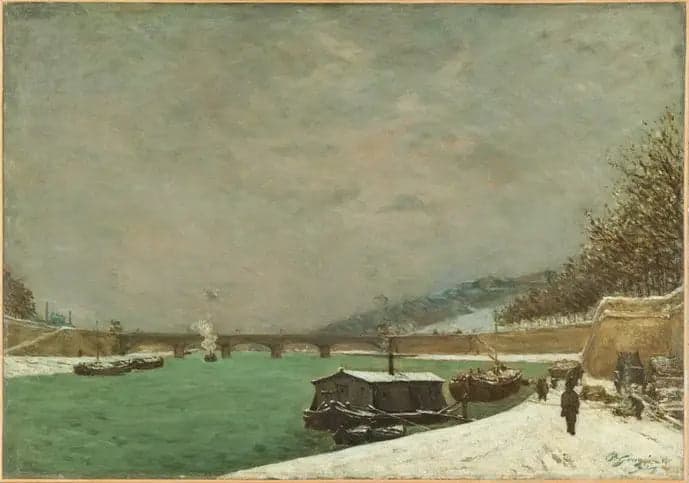
The Seine at the Iéna Bridge, Snowy Weather.
- Original dimensions
- 92.4 x 65.4 cm
- Museum
- Orsay Museum
- Year
- 1875
Scene depicted
Before your eyes, the Parisian winter awakens. Delicate flakes settle on the rooftops, while the Seine, peaceful and majestic, winds between the white facades. The Iéna Bridge, proudly standing, becomes the silent witness of a city that calms under the weight of the snow. Each brushstroke of Gauguin imbues this painting with a delicate and muted atmosphere, capturing the moment suspended in time.
Historical context
Created in the heart of Paris, this painting is emblematic of the rise of Impressionism in the 1870s. Wrapped in the snowflakes of that winter, the scene pays tribute to the timeless beauty of the canvas , captured by the banks of the Seine. The painting now resides in the prestigious Orsay Museum, where it fascinates visitors with its urban and poetic atmosphere.
Place in the artist's career
“The Seine at the Iéna Bridge, Snowy Time” is part of a pivotal period in Gauguin's career. Through this painting , he reveals his emerging sensitivity to nature and urban landscapes. Echoing his contemporary works like “The Vision of the Sermon” and “The Card Players,” this painting marks a turning point towards a more personal and aesthetic exploration, a quest for a fluid and vibrant abstraction.
Anecdote
“Nature inspires me so much that it is difficult not to paint it.” These words from Gauguin resonate when he evokes that Parisian winter. Imagine a calm afternoon, where the city is draped in a cloak of snow, sublimating reality. This pictorial work was born from one of those fleeting moments: an emotional gaze towards the Seine, melancholy and beauty merging on the canvas .