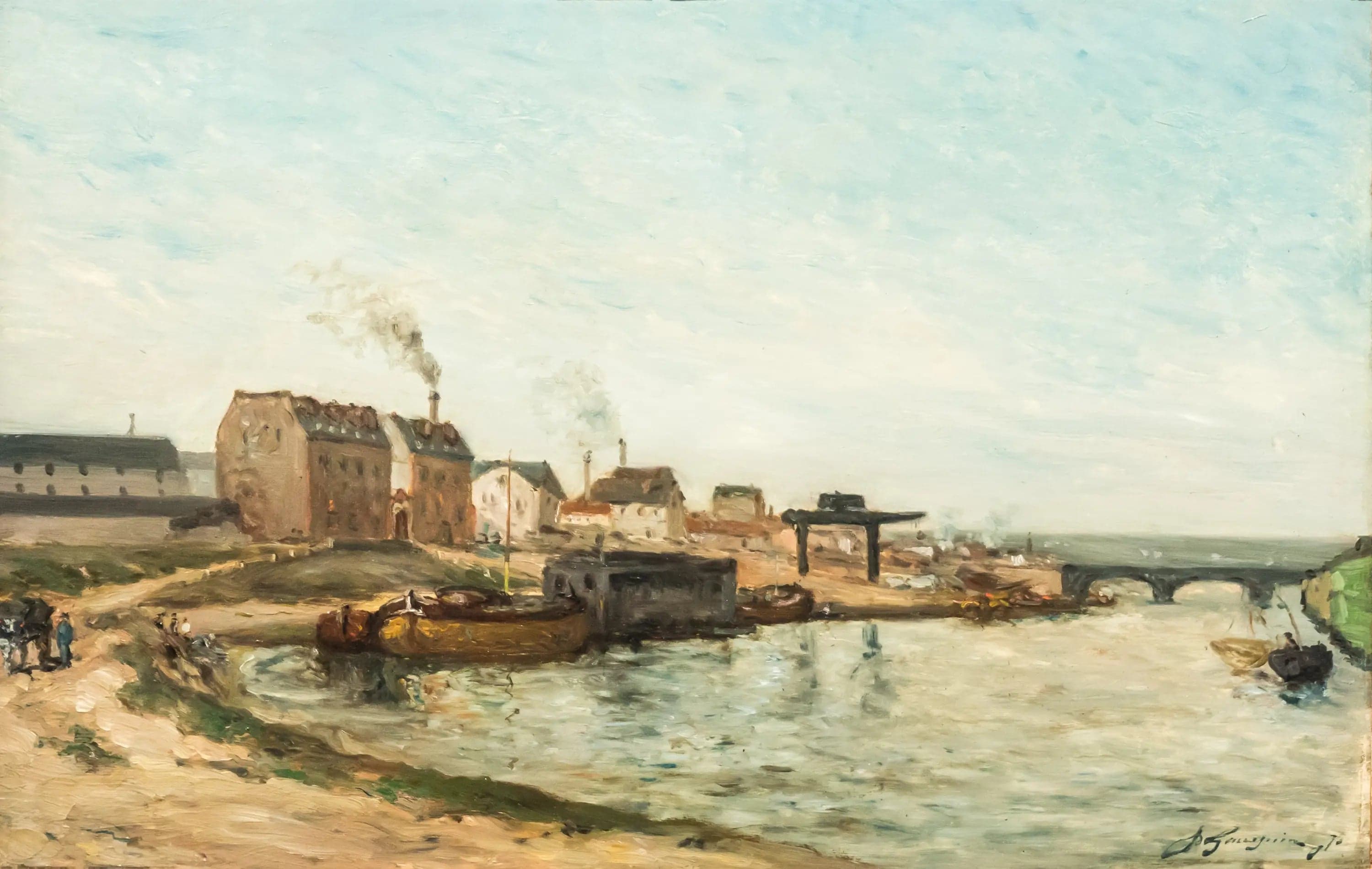
The Seine at the Grenelle Bridge
- Original dimensions
- 44 x 30 cm
- Museum
- Wallraf-Richartz Museum
- Year
- 1875
Scene depicted
This canvas reveals a picturesque scene, where the Grenelle Bridge stands out against the Parisian sky. The vibrant colors and dynamic brushstrokes bring life to this canvas , representing not only the landscape but also the soul of a bustling era. This painting symbolizes a moment of harmony between urbanity and the flow of the Seine, inviting the viewer to a poetic contemplation.
Historical context
Created in 1875, this painting embodies the Paris of the 19th century, a period marked by the emergence of Impressionism . The canvas , which immortalizes the Grenelle Bridge, evokes a moment of urban life, where the river's lights play with the city's architecture, capturing a fleeting beauty. Its current location, at the Wallraf-Richartz Museum , attests to its importance in the artistic heritage.
Place in the artist's career
The Seine at the Grenelle Bridge is situated at a turning point in Gauguin's career, marking his promising beginnings. Alongside works such as Vision after the Sermon and The Yellow Christ , this painting showcases his technical and emotional development, foreshadowing his journey towards a more synthetic style.
Anecdote
“Nature is my greatest master, it taught me to see the light” Gauguin might have said while painting this masterpiece . Imagine him, one spring morning, observing the reflections on the Seine, immersing himself in the shades of blue and gold that dance on the water's surface, inspiring the evocative power of his painting .