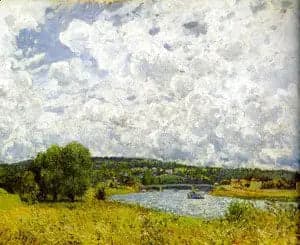
The Seine at Suresnes
- Original dimensions
- 46.4 x 65.3 cm
- Museum
- National Gallery of Scotland
- Year
- 1880
Scene depicted
This painting illustrates a bucolic scene where the Seine gently winds through the green frame of Suresnes. The shimmering reflections of the water, framed by flowering trees, convey a peaceful, almost utopian atmosphere. Sisley uses natural light to evoke a season in full bloom, where every detail becomes a tribute to the ephemeral beauty of nature.
Historical context
Created in 1880, this painting is part of the Impressionist movement, an artistic movement that flourished in France at the end of the 19th century. Located in Suresnes, a charming town near Paris, this canvas captures the fleeting moment of a landscape, oscillating between light and shadow. The painting is currently displayed at the National Gallery of Scotland, a prestigious setting that allows one to appreciate the delicacy of the work in dimensions of 46.4 x 65.3 cm.
Place in the artist's career
Positioning La Seine à Suresnes as one of the peaks of Alfred Sisley's career, this painting testifies to his growing mastery of light and color play. Compared to other iconic works like Le Pont de Villeneuve-la-Garenne and La Gare de Moret, this canvas marks a period of maturity where the artist concentrates all his talent on capturing the delicate nuances of nature in full change.
Anecdote
“Nature is a poem to which I aspire to give my own voice,” Sisley is said to have declared while contemplating the Seine. It was at dawn on a gentle sunny morning that the artist allowed himself to be captivated by the simple beauty of this landscape. His brushstrokes testify to an unwavering love for nature, offering a deep resonance to the essence of his painting .