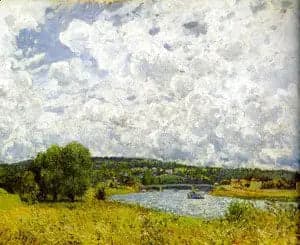
The Seine at Suresnes
- Original dimensions
- 73.5 x 60.3 cm
- Museum
- Orsay Museum
- Year
- 1877
Scene depicted
The painting depicts the Seine winding peacefully, surrounded by lush greenery and flowering houses. The composition, full of nuances, invites the viewer to dive into this harmony between water and land, where light plays a central role, sparkling on the current and dancing on the leaves. Through this masterpiece, Sisley conveys an almost palpable atmosphere, evoking the gentle murmur of water under the light breath of the wind.
Historical context
Created in 1877, The Seine at Suresnes is set in the Impressionist context, a time when light and color dominated art. This iconic painting by Alfred Sisley captures the peaceful beauty of the river at Suresnes, a charming town in the Paris region. The work is currently housed in the Orsay Museum, where its aura continues to inspire visitors.
Place in the artist's career
The Seine at Suresnes is a significant work in the career of Alfred Sisley , representing the emotional peak of his Impressionist period. Alongside other major compositions such as Impression, Sunrise and The Bridge at Moret on the Seine , this pictorial work reveals the evolution of Sisley's technique, moving from a figurative approach to a more free and sensory representation of nature.
Anecdote
“Painting is a hymn to nature, an ode to fleeting moments.” These words resonate like an echo of inspiration from a spring morning, when the artist settled by the Seine, facing the vibrant light and reflections in the water. This emotion is palpable in The Seine at Suresnes , where each brushstroke seems to tell a story of beauty and serenity.