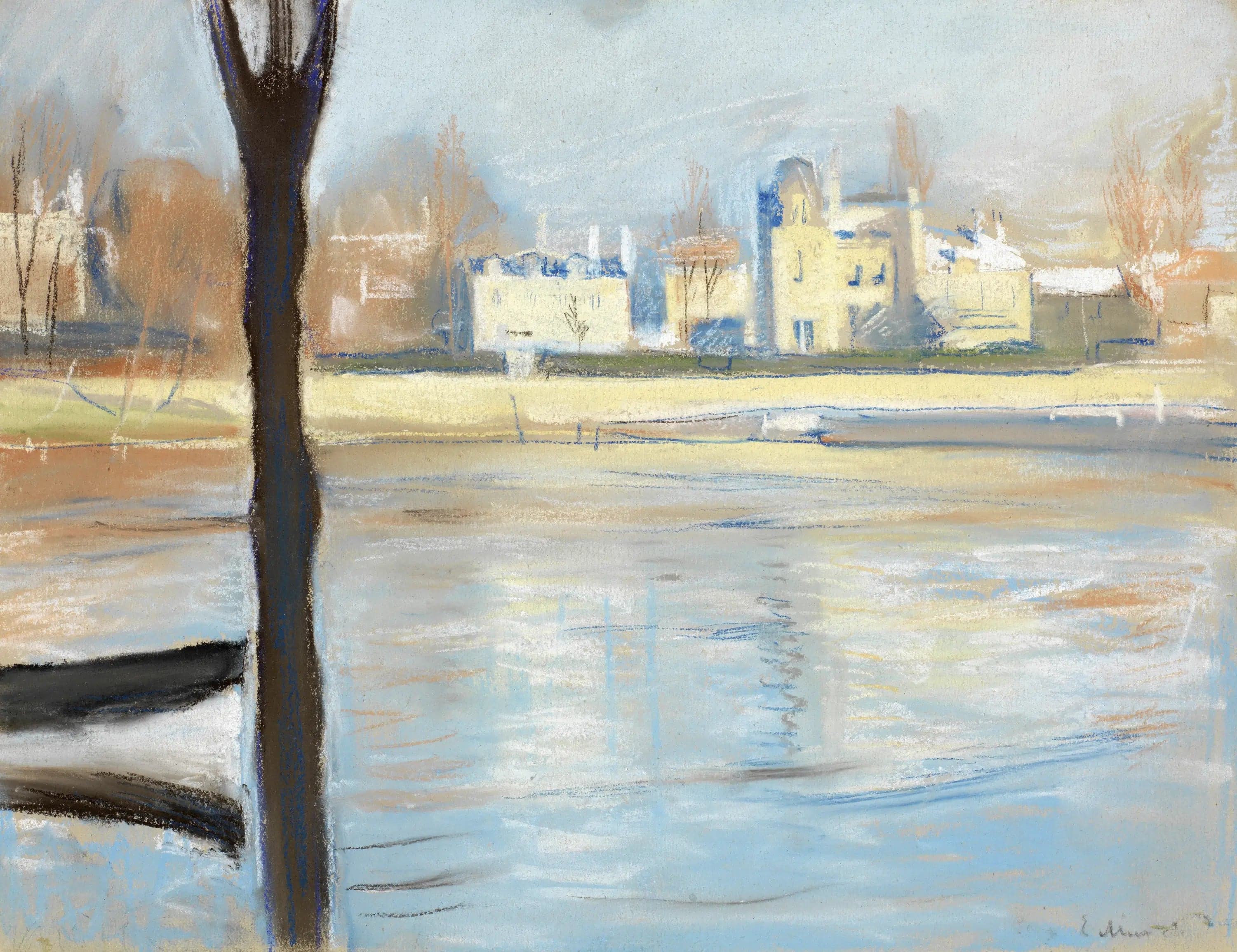
The Seine at Saint-Cloud
- Original dimensions
- 38 x 46 cm
- Museum
- Munch Museum
- Year
- 1890
Scene depicted
In this painting , Munch captures the tranquility of the Seine at Saint-Cloud, revealing a bright and serene atmosphere. The reflections of the trees in the water and the sky of a brilliant blue create a harmonious composition that invites contemplation. Each element tells a story, that of a suspended moment, of a barely perceptible nostalgia, enveloping the viewer in a bubble of dreams.
Historical context
In the soft light of a morning in 1890, Edvard Munch created this iconic painting in Saint-Cloud, a charming site located near Paris. This canvas bears witness to the beginnings of symbolism , an innovative artistic movement where emotion prevails over reality. Today, this painting rests in the Munch Museum, where visitors can admire its beauty and dimensions, reinforcing its importance in the history of art.
Place in the artist's career
La Seine à Saint-Cloud stands as a pivotal work in Munch's career, illustrating his transition to a more introspective style. Compared to The Scream and Love , this canvas draws attention to the sweetness of life, marking a balance between brutal emotion and serene beauty that defines his artistic journey.
Anecdote
“Nature is my greatest inspirer.” This quote from Munch resonates deeply when observing his masterpiece , capturing a fleeting moment of a spring morning, where the Seine whispers like a secret whispered among the leaves. Each brushstroke in La Seine à Saint-Cloud evokes that magical moment when the artist merges with the beauty of the landscape.
Major exhibitions
Munch and France