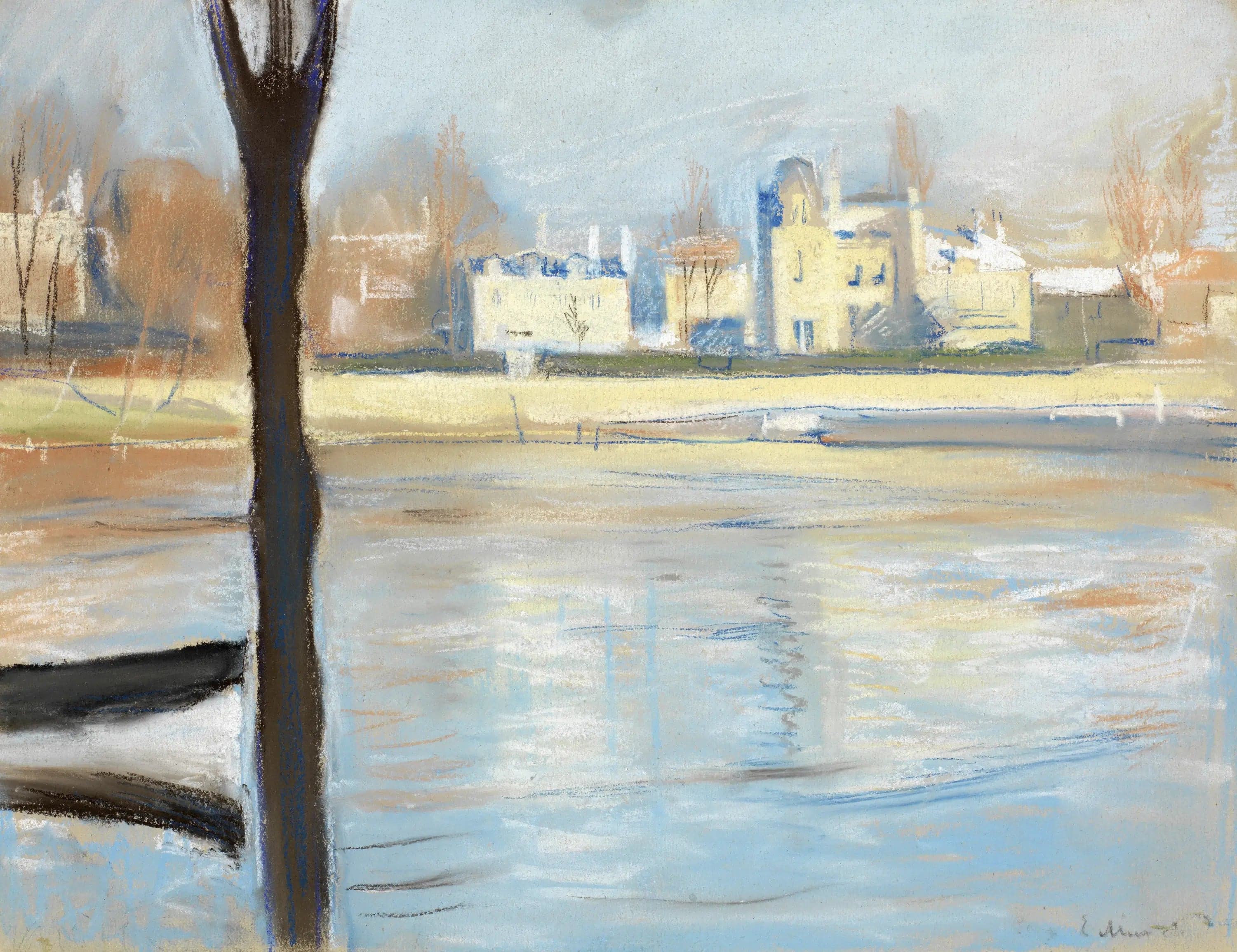
The Seine at Saint-Cloud
- Original dimensions
- 27 x 35 cm
- Museum
- Stenersen Museum
- Year
- 1890
Scene depicted
This canvas depicts a serene landscape, where the Seine gently winds, surrounded by majestic trees and often capricious skies. The reflections in the water reveal a delicate harmony between movement and tranquility. Through each brushstroke, Munch explores the duality of nature, guiding the viewer on a visual journey filled with inner reflections and peace.
Historical context
Created in 1890, The Seine at Saint-Cloud is set in the Impressionist context, at a time when Edvard Munch , a precursor of Symbolism , explored the depths of the human soul. This painting is imbued with the Parisian atmosphere, near the Seine, an iconic place for the artist. This canvas , currently exhibited at the Stenersen Museum, captures the essence of a vibrant era, through a dimension of 27 x 35 cm.
Place in the artist's career
The Seine at Saint-Cloud marks a significant milestone in Munch's career, reflecting a balance between his emerging Impressionism and his evolution towards more symbolic compositions. This painting can be paralleled with works such as The Scream and The Dance of Life , illustrating how his aesthetic transforms, moving from serene landscapes to more turbulent emotions.
Anecdote
“Art is an echo of the deepest emotions.” This quote from Munch resonates particularly when thinking about the genesis of his masterpiece . Inspired by a peaceful morning in Saint-Cloud, the artist was touched by the fleeting and poignant beauty of light on the water, conveying an emotion that transcends time and immerses the viewer in his intriguing universe.
Major exhibitions
Munch and France