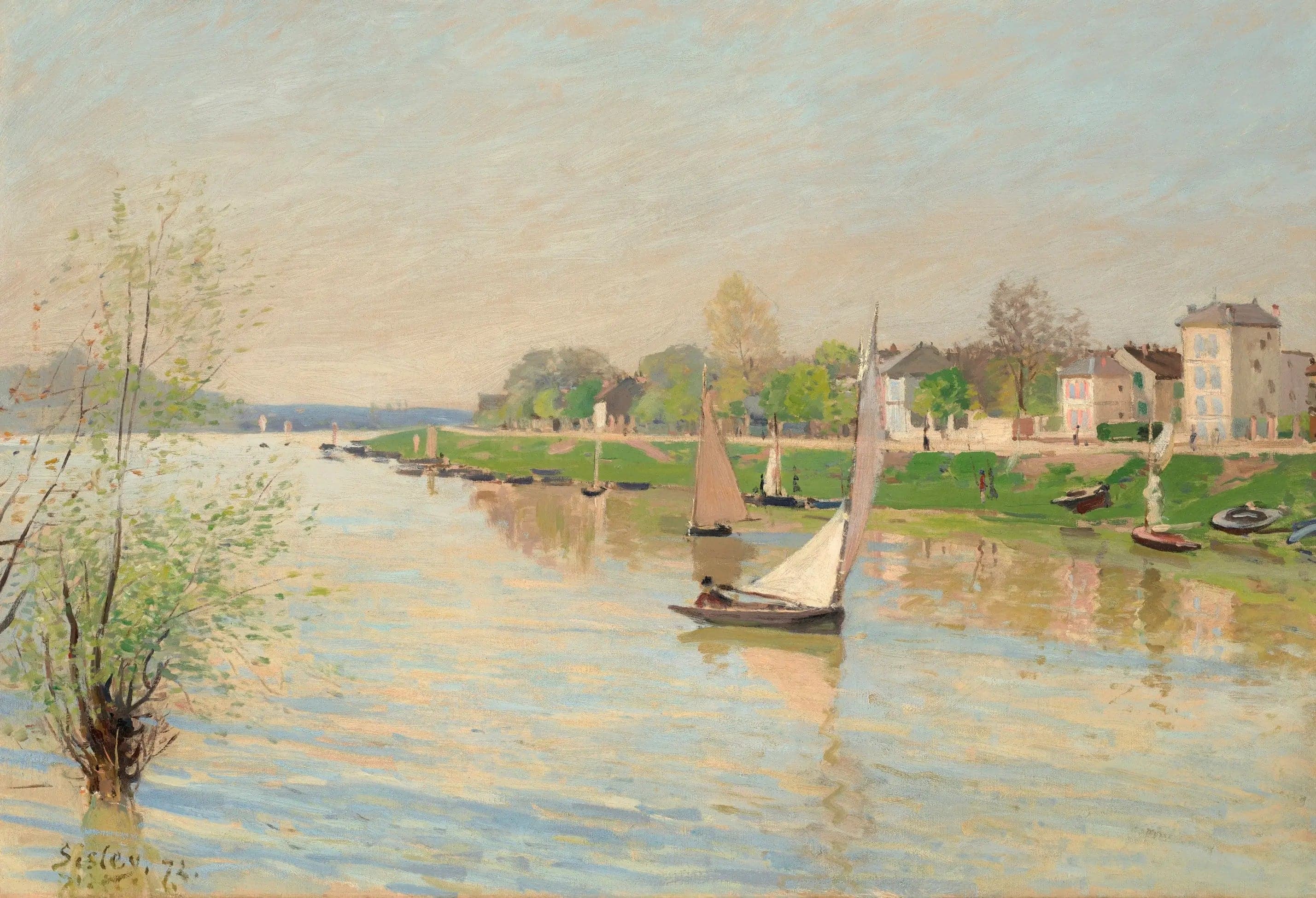
The Seine at Argenteuil
- Original dimensions
- 72.5 x 49.5 cm
- Museum
- Not specified
- Year
- 1872
Scene depicted
The painting “La Seine à Argenteuil” depicts a serene vision of the river, lined with majestic trees and peaceful boats. Sisley thus immerses us in a moment of tranquility, where light reflects on the water, creating an almost ethereal atmosphere. Each brushstroke testifies to the love that the artist has for nature and his desire to capture its infinite variations.
Historical context
Created in 1872, this painting takes shape on the banks of the Seine, in Argenteuil, an emblematic city of the Impressionist movement. Alfred Sisley , a central figure of this artistic era, captures here the fleeting beauty of a natural environment in the heart of the Île-de-France region. This canvas , today not specified in a public collection, manifests through its dimensions of 72.5 x 49.5 cm, a moment suspended on the canvas where light and water unite in a sensual harmony.
Place in the artist's career
Placing La Seine à Argenteuil at a pivotal moment in a promising career, Sisley achieves here a stylistic maturity. Through this canvas, he establishes a dialogue with other paintings such as “Impression, Sunrise” by Claude Monet and “The Charing Cross Bridge” by Thomas Boudin, highlighting his evolution as a discerning Impressionist artist.
Anecdote
“Nature is my purest inspiration,” Sisley might have said while observing the scene in the early morning, when the soft reflections of the water began their dance. These moments of contemplation greatly inspired the masterpiece that is La Seine à Argenteuil , immortalizing this vibrant and enchanting landscape.