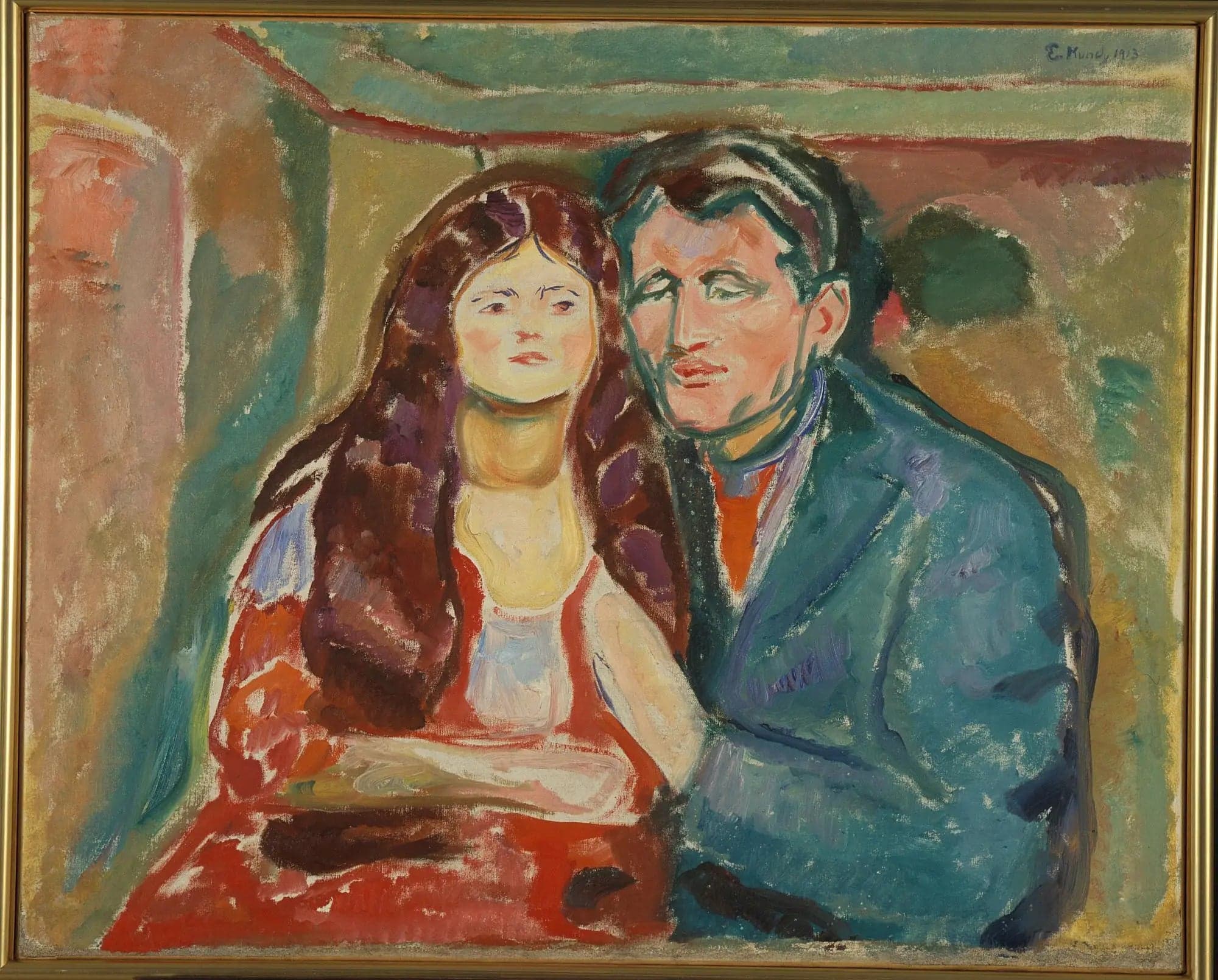
The Seducer
- Original dimensions
- 119.5 x 98.5 cm
- Museum
- Munch Museum
- Year
- 1913
Scene depicted
“The Seducer” depicts a subtle and complex interplay of desire, isolation, and seduction. Munch captures a moment of interaction between the characters, integrating elements of emotional tension. Each glance, each posture becomes a narrative in itself, inviting the viewer to dive into the depths of a quest for love and attention that unfolds at the heart of human relationships.
Historical context
Created in 1913, this painting is emblematic of the expressionist movement, an innovative artistic current that reflects intense emotions and inner turmoil. The canvas is currently exhibited at the Munch Museum in Oslo, Norway, a place rich in history where the artist drew his inspiration. This remarkable canvas measures 119.5 x 98.5 cm, capturing a vibrant and poignant essence.
Place in the artist's career
This canvas occupies a central place in Munch's career, ranking among his most emblematic works. While his masterpiece , “The Scream,” expresses universal despair, “The Seducer” highlights the complexity of human interactions. The periods of creation converge, illustrating the evolution of his pictorial style, where introspection and the outside world meet in an inevitable creative surge.
Anecdote
“Art must be a catharsis, a release of repressed emotions,” Munch might have said, as he drew inspiration from a misty morning in Oslo, where a fleeting encounter ignited his imagination. In this context, the painting “The Seducer” becomes a reflection of a stolen moment, where each brushstroke evokes the delicate dance of human feelings.
Major exhibitions
Edvard Munch and his models: 1912-1943