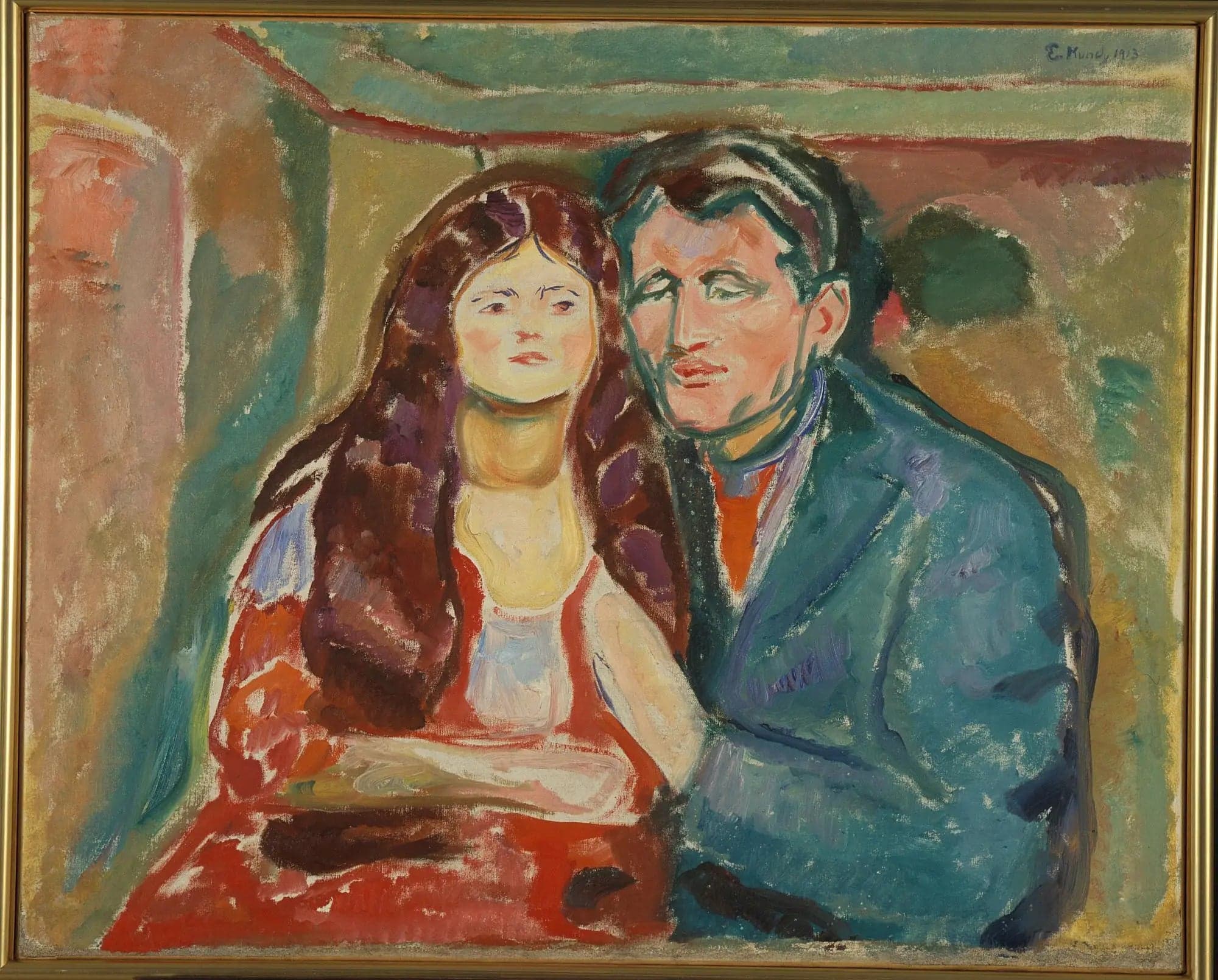
The Seducer
- Original dimensions
- 100 x 80.5 cm
- Museum
- Munch Museum
- Year
- 1913
Scene depicted
The painting “The Seducer - Edvard Munch ” features a man and a woman in an evocative posture. The man, with a piercing gaze, seems to charm the woman, whose expression oscillates between interest and concern. This captivating scene immerses the viewer in the complexities of human relationships, where love, desire, and manipulation intertwine in a tumultuous dance.
Historical context
Created in 1913, The Seducer finds its roots in the bustling streets of Oslo, Norway, a city that witnessed the emergence of the expressionist movement. At that time, Munch distinguished himself as one of the leaders of this innovative art, exploring the meanders of the human soul. The painting , currently exhibited at the Munch Museum , reflects an era imbued with melancholy and passion, whose dimensions of 100 x 80.5 cm do not go unnoticed.
Place in the artist's career
Positioned at the heart of Munch's mature period, The Seducer symbolizes his evolution towards a more introspective style. In parallel, his earlier works such as The Scream and Madonna highlight human suffering, while The Seducer excavates the nuances of desire and seduction, testifying to a growing mastery of composition .
Anecdote
“I paint life, not light,” Munch would say when describing his creative process. It was on a spring morning, as he wandered through the alleys of Oslo, that a feminine silhouette inspired him. This fleeting encounter became the very essence of The Seducer , a canvas full of emotional contrasts and intense feelings.
Major exhibitions
Edvard Munch and his models: 1912-1943