The Sea of Ice
- Original dimensions
- 126.9 x 96.7 cm
- Movement
- romanticism
- Museum
- Hamburg Kunsthalle
- Year
- 1823
Scene depicted
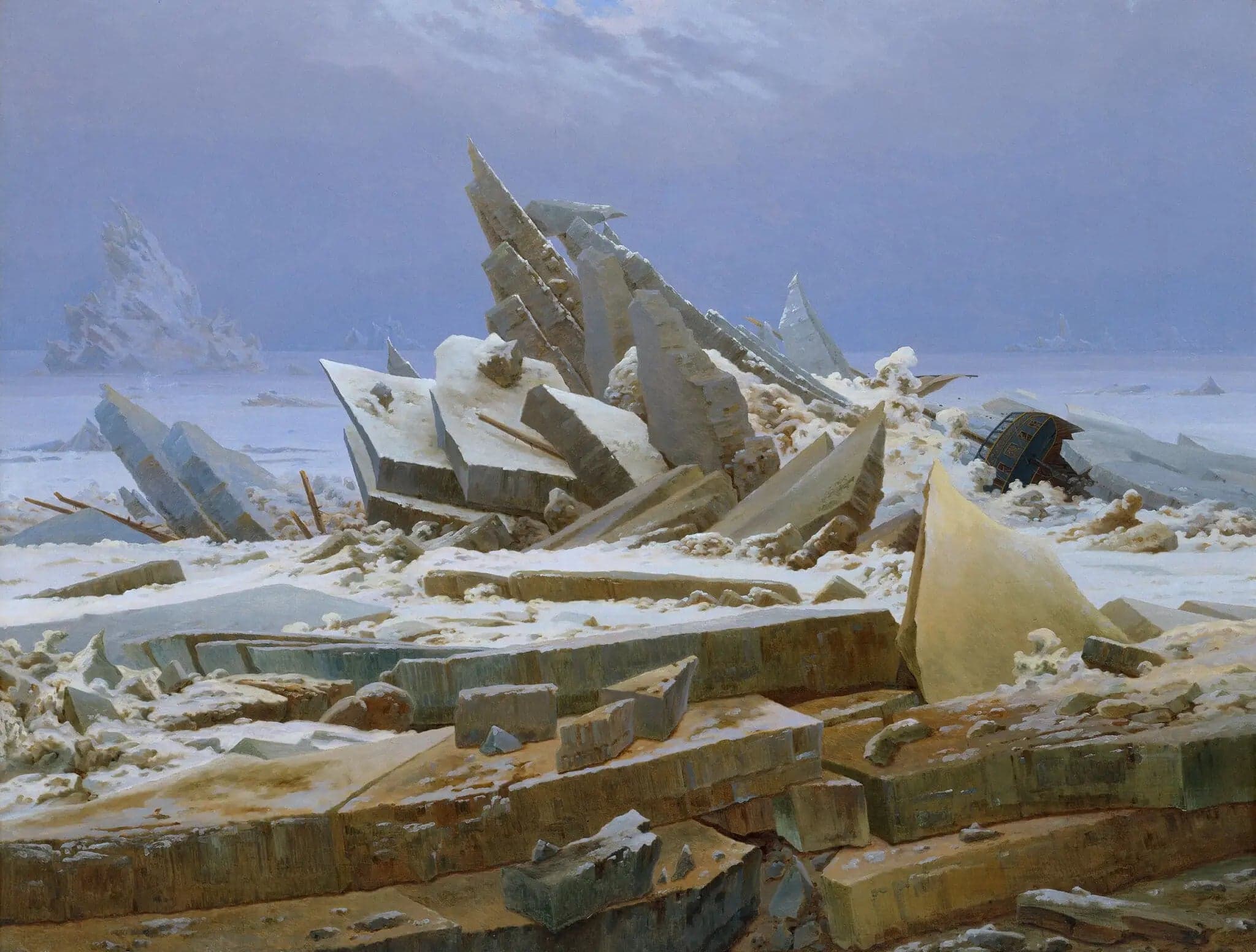
The scene captured in The Sea of Ice is both grand and meditative. It depicts an icy landscape where floating ice blocks intertwine with snow-capped peaks. Friedrich captures the sublime of the Nordic landscape, inviting us on an introspective journey into the heart of nature. The contrasts between the deep blue of the ice and the bright white of the snow evoke a majesty that is both calm and tragic.
Historical context
Artwork: The Sea of Ice |BRK| Artist: Caspar David Friedrich |BRK| Year: 1823 |BRK| Museum: Hamburg Kunsthalle |BRK| Dimensions: 126.9 x 96.7 cm |BRK| Artistic Movement: romanticism |BRK|
Place in the artist's career
The Sea of Ice fits into a period of maturity in Friedrich's career, marking a stylistic peak in his exploration of romantic landscapes. Indeed, alongside works such as The Wanderer above the Sea of Fog and The Oak of Death , this painting testifies to his technical evolution, where atmosphere and emotion take precedence over mere representation. Here, Friedrich refines his pictorial language, translating a fusion between human sentiment and natural immensity.
Anecdote
Caspar David Friedrich , immersed in contemplation of natural landscapes, once declared: "Painting is an echo of nature, a reflection of our soul." This quote resonates deeply with the genesis of The Sea of Ice , born on a cold morning when crystalline light danced on the icy surface of the mountains. This moment of grace infused an evocative power into his painting , vibrating with human emotion in the face of natural majesty.