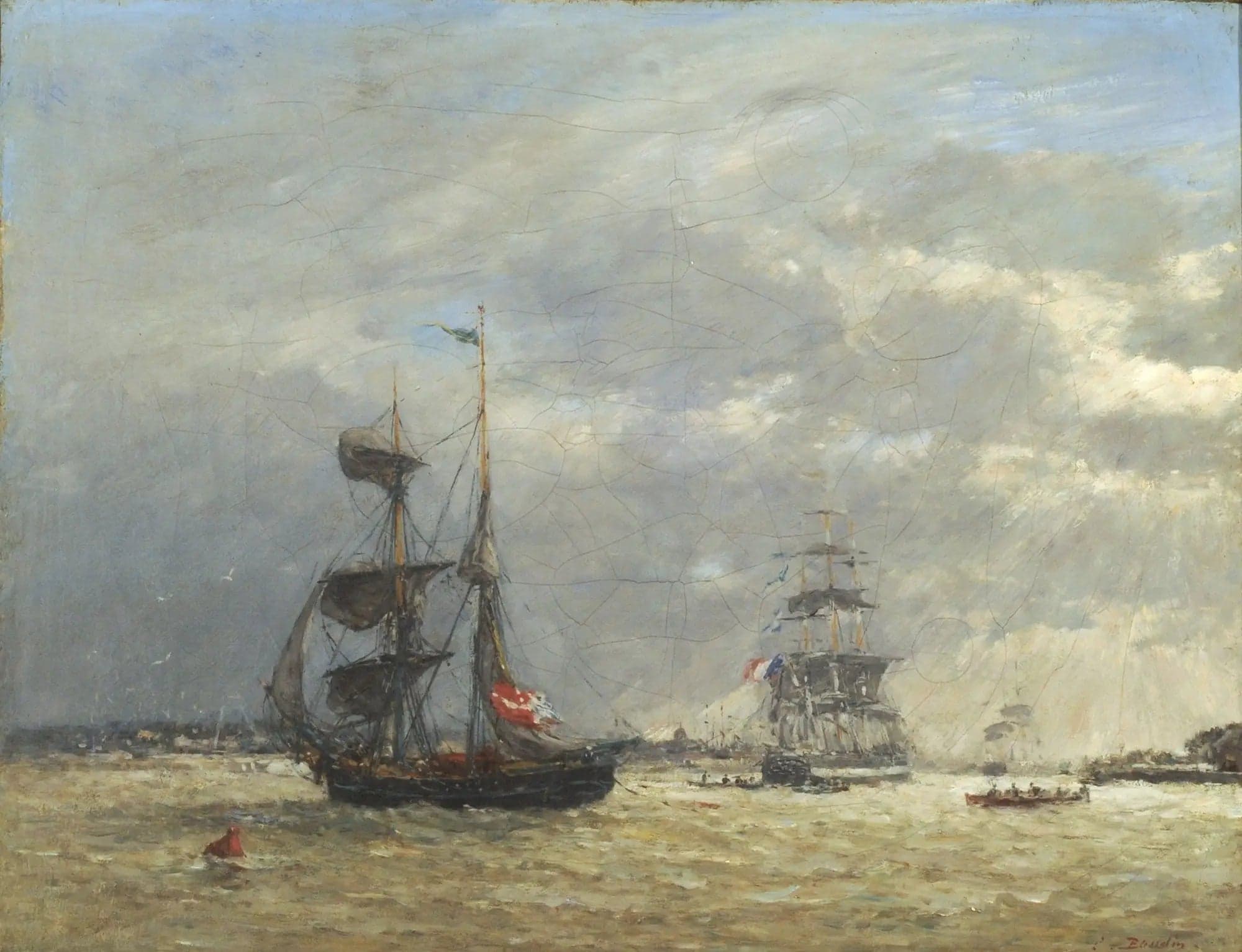
The Scheldt in Stormy Weather
- Original dimensions
- 56.5 x 43 cm
- Museum
- National Museum of Fine Arts Buenos Aires
- Year
- 1872
Scene depicted
With a careful glance, the painting reveals the tumult of the sky above the Scheldt, a river vibrant with a dramatic palette. The waves stir, and the sky, swirling with grays and whites, evokes a living nature, both threatening and beautiful. This painting , a true Impressionist composition, manages to make one feel the breath of the wind, to hear the sound of the waves crashing against the shore.
Historical context
Created in 1872, the painting "The Scheldt in Stormy Weather" is part of the Impressionist movement, emerging in a historical context where light and atmosphere begin to influence the canvas . At that time, Eugène Boudin , a pioneer of this artistic movement, captures the sublime tableau of stormy skies, a reflection of his seaside travels along the Scheldt in Belgium. Currently, this work is carefully preserved at the National Museum of Fine Arts in Buenos Aires, where it continues to amaze art lovers.
Place in the artist's career
This painting marks a pivotal period in Boudin's career, illustrating his transition from a local artist to a recognized master within the Impressionist movement. By comparing "The Scheldt in Stormy Weather" to works like "The Beach at Trouville" and "Boats in the Port of Honfleur," one perceives a fascinating evolution in his technique and exploration of light and atmospheric effects.
Anecdote
“Light is the key to everything,” said Boudin. Imagine him, sitting on the bank, one foggy morning, watching the dark clouds dance above the choppy waters. It is in this electric atmosphere that he begins to paint, intense emotions imbuing each brushstroke. This inspiration gave birth to a masterpiece whose captured energy still resonates on the canvas .