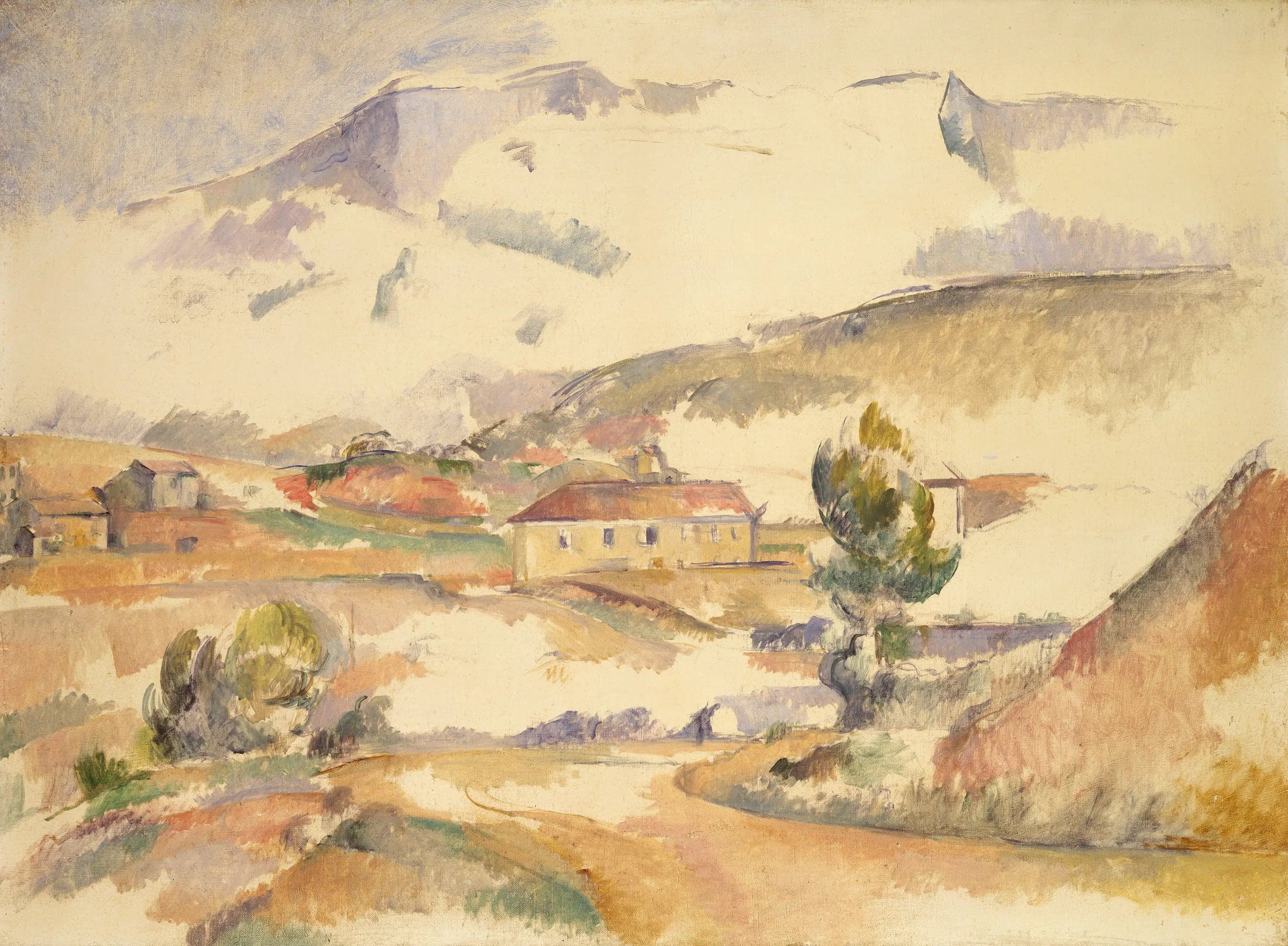
The Sainte-Victoire Mountain seen from the Bayeux Bridge in Meyreuil
- Original dimensions
- 91.3 x 67.2 cm
- Museum
- National Gallery of Art
- Year
- 1887
Scene depicted
In this canvas , Cézanne depicts the iconic silhouette of the Mountain Sainte-Victoire, enveloped in a soothing atmosphere. The mountains rise powerfully, while the sky, tinged with blue, testifies to the natural play of light that bathes the Provençal land. The brushstrokes, with their vibrant colors, convey not only beauty but also the vibrant soul of this bucolic scene, touching the viewer's heart.
Historical context
Created in 1887, this painting embodies its roots in the charming region of Provence, more precisely in Meyreuil. It belongs to the Impressionist movement, a time when artists sought to capture the nuances of light and the echoes of nature. Today, the canvas proudly rests at the National Gallery of Art , an institution that meticulously preserves artistic heritage.
Place in the artist's career
This canvas represents a crucial milestone in Cézanne's career, marking a period of maturity and stylistic exploration. Associated with other works such as “The Large Bathers” or “The Artist's House,” it illustrates a bold evolution where sensitivity and technique meet to form dynamic and unique compositions.
Anecdote
“I want to capture all the striking beauty of the landscapes around me, each brushstroke is a tribute to this light that envelops me.” These words still resonate today through Cézanne's painting , evoking the day he stood at the edge of the Bayeux Bridge, absorbing inspiration from the Mountain Sainte-Victoire, majestically rising before him. This pictorial work is the expression of that encounter, a moment captured for eternity.