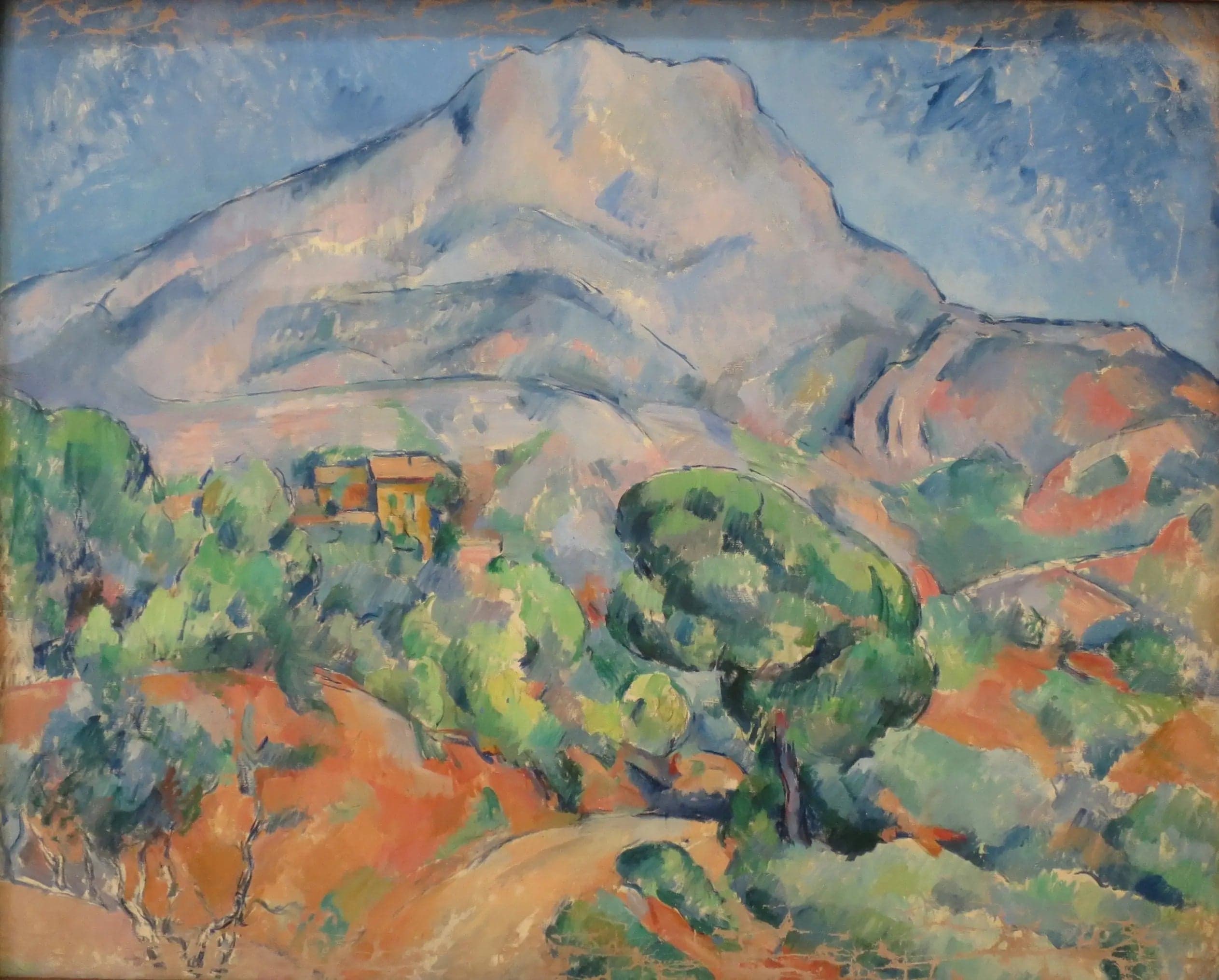
The Sainte-Victoire Mountain above the Tholonet Road
- Original dimensions
- 99 x 78 cm
- Museum
- Hermitage Museum
- Year
- 1900
Scene depicted
This painting illustrates the majesty of the Mountain Sainte-Victoire, a symbol of Provence, majestically rising above the Tholonet road. The canvas captures the Mediterranean light dancing on the slates and pines, transforming the landscape into a vibrant and dynamic composition. Far from being a mere landscape view, this painting reveals the very soul of the region, with its shimmering hues and serene atmosphere.
Historical context
Created in 1900 in France, The Mountain Sainte-Victoire above the Tholonet Road is an iconic work of the post-impressionist movement, a trend that seeks to capture natural light and colors. This painting, which resides in the Hermitage Museum , testifies to a time of artistic upheaval where Cézanne redefined the codes of painting . With dimensions of 99 x 78 cm, this canvas stands as a timeless masterpiece.
Place in the artist's career
Positioned at the heart of Cézanne's career, The Mountain Sainte-Victoire above the Tholonet Road represents the pinnacle of his pictorial exploration. In parallel with The Large Bathers and The House of the Pioneers , this painting reveals the stylistic evolution of the artist, marked by a gradual development towards an abstraction of form and color.
Anecdote
“Nature is my true muse,” said Cézanne, thus evoking his fusion relationship with the world around him. One sunny morning near Tholonet, a scent of wildflowers floated in the air, infusing his canvas with inspiration drawn from the pure beauty of the Provençal landscapes. This moment of artistic awakening is found in every brushstroke of The Mountain Sainte-Victoire .