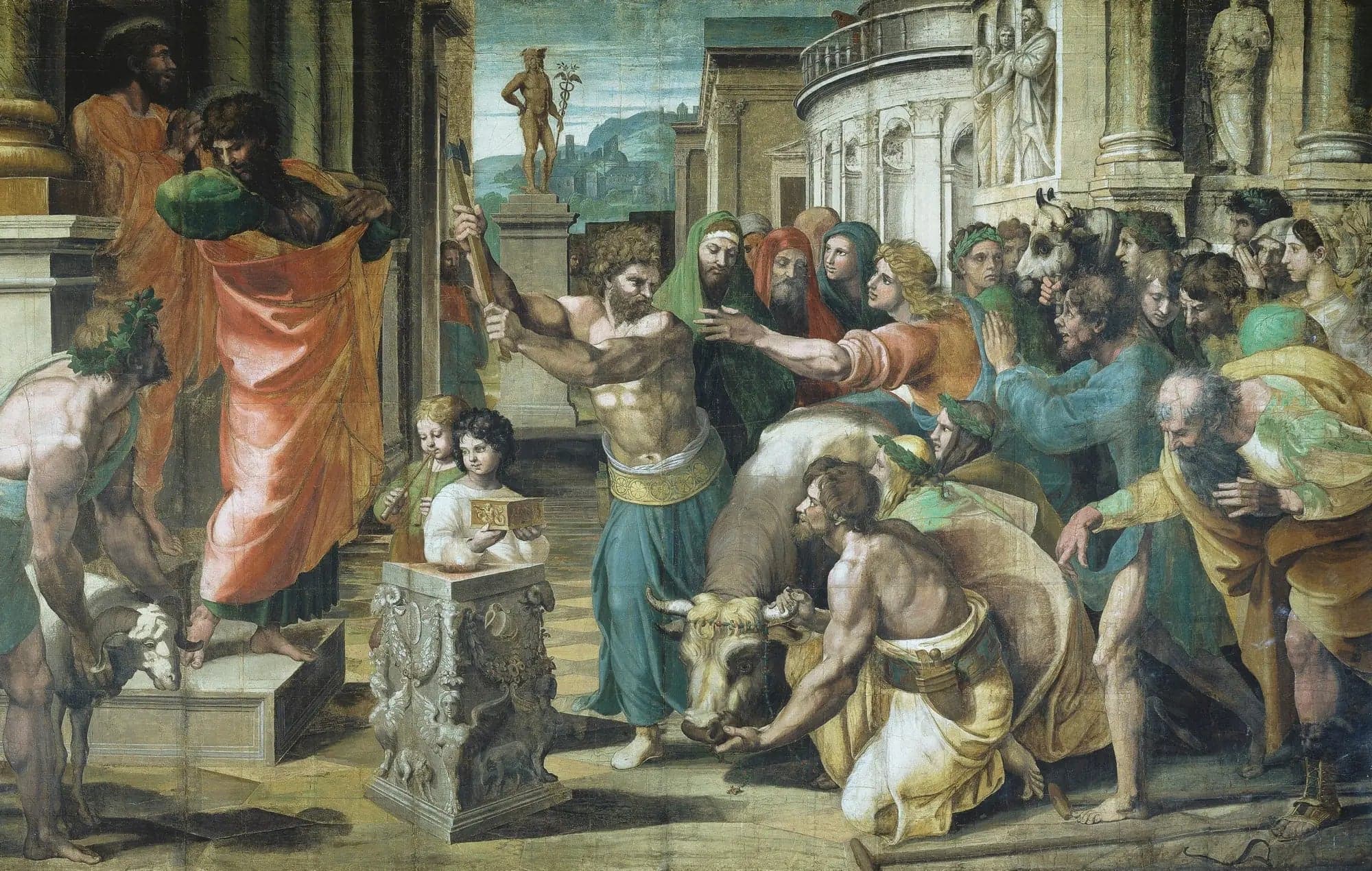
The Sacrifice of Lystra
- Original dimensions
- 540 x 350 cm
- Museum
- Victoria and Albert Museum
- Year
- 1515
Scene depicted
At the heart of the painting , this dramatic scene illustrates the biblical narrative of the apostle Paul, who sacrifices his freedom to preach love and truth. The characters gather around an act of empathy, blending powerful emotions and sincere gazes, thus bringing narrative depth to the pictorial work.
Historical context
Created in 1515, this painting emblematic of Raphael Sanzio comes to life in Rome, at the heart of the Renaissance , a flamboyant artistic movement that rediscovers classical values while placing humanity and its emotion at the center of art. Today, this canvas flourishes at the Victoria and Albert Museum in London, where its majesty of 540 x 350 cm continues to captivate eyes and hearts.
Place in the artist's career
The Sacrifice of Lystra represents the stylistic peak of young Raphael, alongside papal residences like The School of Athens and The Madonna of Saint Sixtus. This work testifies to a remarkable technical evolution, where dynamic movement and harmonious composition intertwine, capturing the very essence of the Renaissance .
Anecdote
Raphael is said to have declared on a sunny morning: "Art is the voice of passionate souls." These words resonate with the subtlety of his masterpiece , inspired by the song of birds and the sweetness of spring, evoking the vibrant life that surrounded him and infusing a soft light into the canvas .