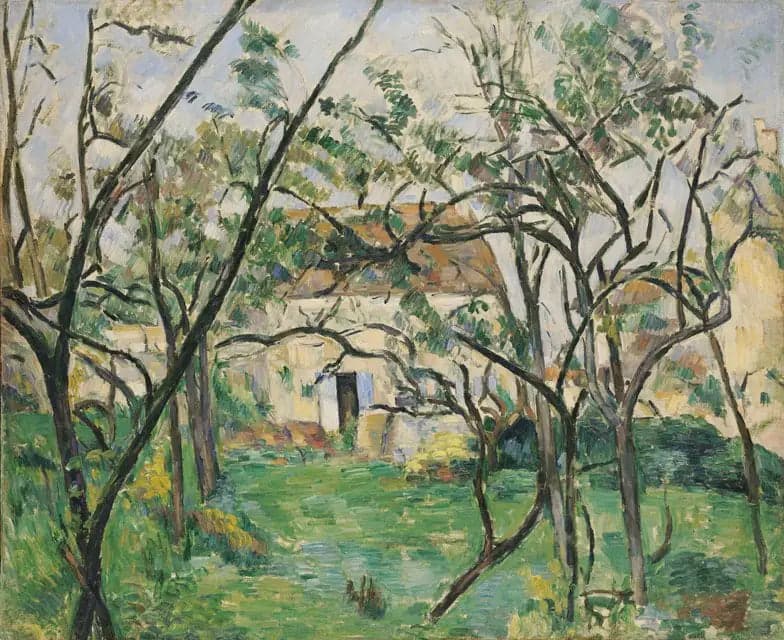
The Rustic House
- Original dimensions
- 73 x 57 cm
- Museum
- Wadsworth Atheneum
- Year
- 1880
Scene depicted
In The Rustic House , Cézanne offers us an idyllic vision of rural life. The composition, both simple and bold, reveals a house flanked by lush landscapes. The vibrant colors evoke the warmth of the southern sun, while the structure of the house seems to dance to the rhythm of the landscape, establishing a palpable harmony between human habitat and the surrounding nature.
Historical context
Created in 1880, the painting The Rustic House by Paul Cézanne is set in an artistic context marked by post-impressionism . At that time, Cézanne, originally from Aix-en-Provence, sought to redefine the contours of color and form through his paintings . This canvas , now displayed at the Wadsworth Atheneum , bears witness to a time when nature and architecture merge into a visual harmony of great rarity. Its dimensions, 73 x 57 cm, allow for a total immersion in its universe.
Place in the artist's career
The Rustic House is a key milestone in Cézanne's career. It is part of a period of creative maturity, close to the golden age of the artist's paintings . Compared to masterpieces such as The Card Players and Mont Sainte-Victoire , this canvas illustrates the transition from impressionist style to a more structured approach, laying the groundwork for what would later be called cubism .
Anecdote
“True beauty lies in realism , where the still becomes alive.” This is a thought that Paul Cézanne might have had while painting The Rustic House . Imagine him, one spring morning, walking through the empty streets of his native Aix-en-Provence, immersing himself in the whisper of the valley, inspired by the light caressing the facades of the houses. It is this emotion, palpable and unique, that emanates from every brushstroke of this masterpiece .