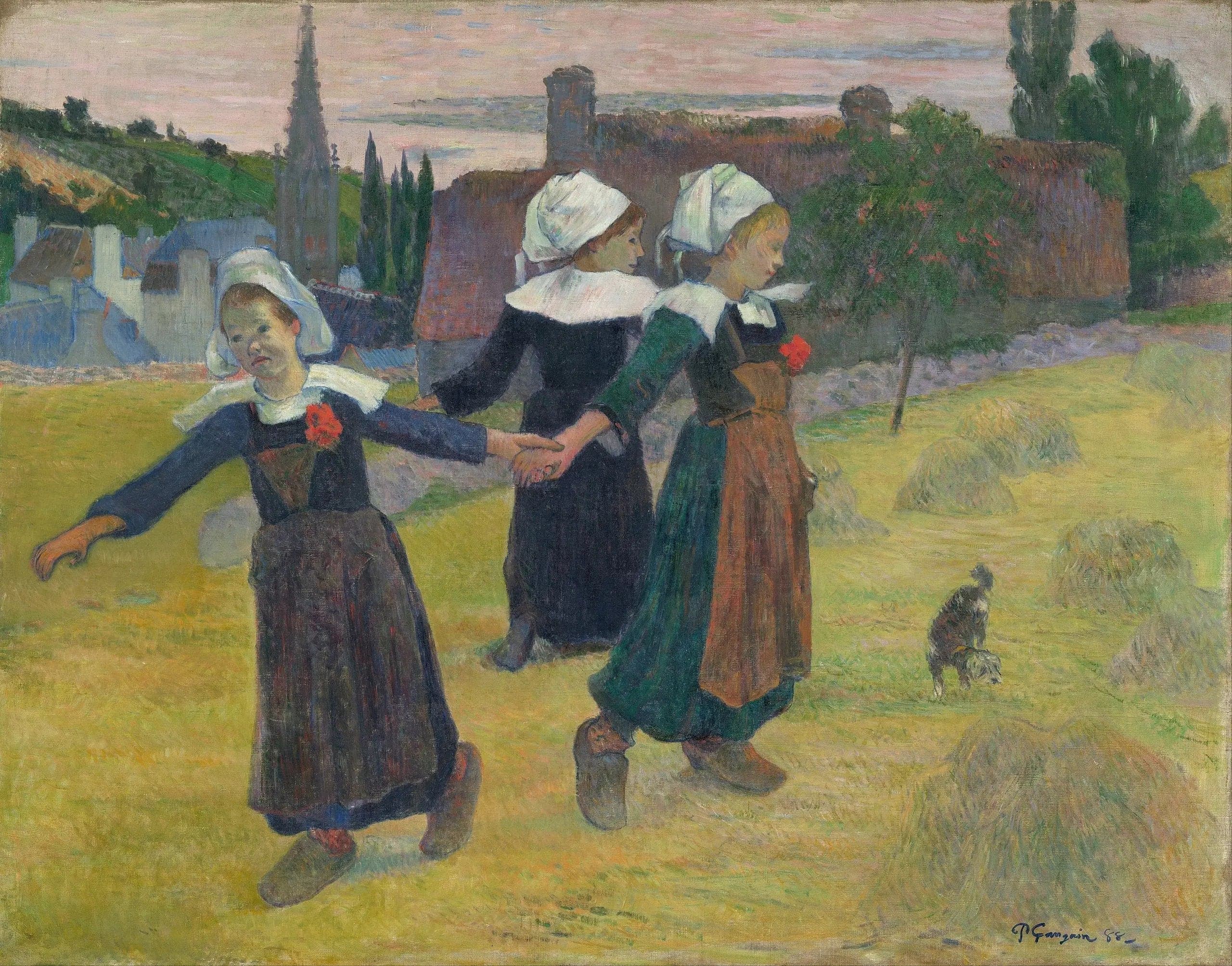
The Round of the Little Bretonnes
- Original dimensions
- 92.7 x 73 cm
- Museum
- National Gallery of Art
- Year
- 1888
Scene depicted
In “The Round of Little Breton Girls,” Gauguin opts for a lively and dynamic composition where several little girls hold hands. This scene evokes the carefreeness and simplicity of childhood life, immersed under a sky of azure. The pictorial work transforms into a hymn to innocence and freedom, thus capturing the spirit of an era.
Historical context
This painting is iconic, created in 1888, immersing the viewer in the colorful and emotional universe of Brittany. In the midst of the post-impressionist period, Paul Gauguin chose to depict little Breton girls, symbols of local culture, while exploring themes of innocence and joy. Today, this canvas is preserved at the National Gallery of Art, a true guardian of artistic history.
Place in the artist's career
A pivotal moment in Gauguin's journey, “The Round of Little Breton Girls” illustrates a period of artistic maturity. In resonance with “Vision after the Sermon” and “Twelve Women of Tahiti,” this painting denotes an evolution towards more introspective themes and increased stylization, marking a turning point in his approach.
Anecdote
As Gauguin said, “Painting is an art of living.” He drew his inspiration from the heart of Breton traditions, on a bright morning where the laughter of children echoed in the distance. Each brushstroke of this canvas testifies to a preserved childhood, a burst of life that emanates from the painting.