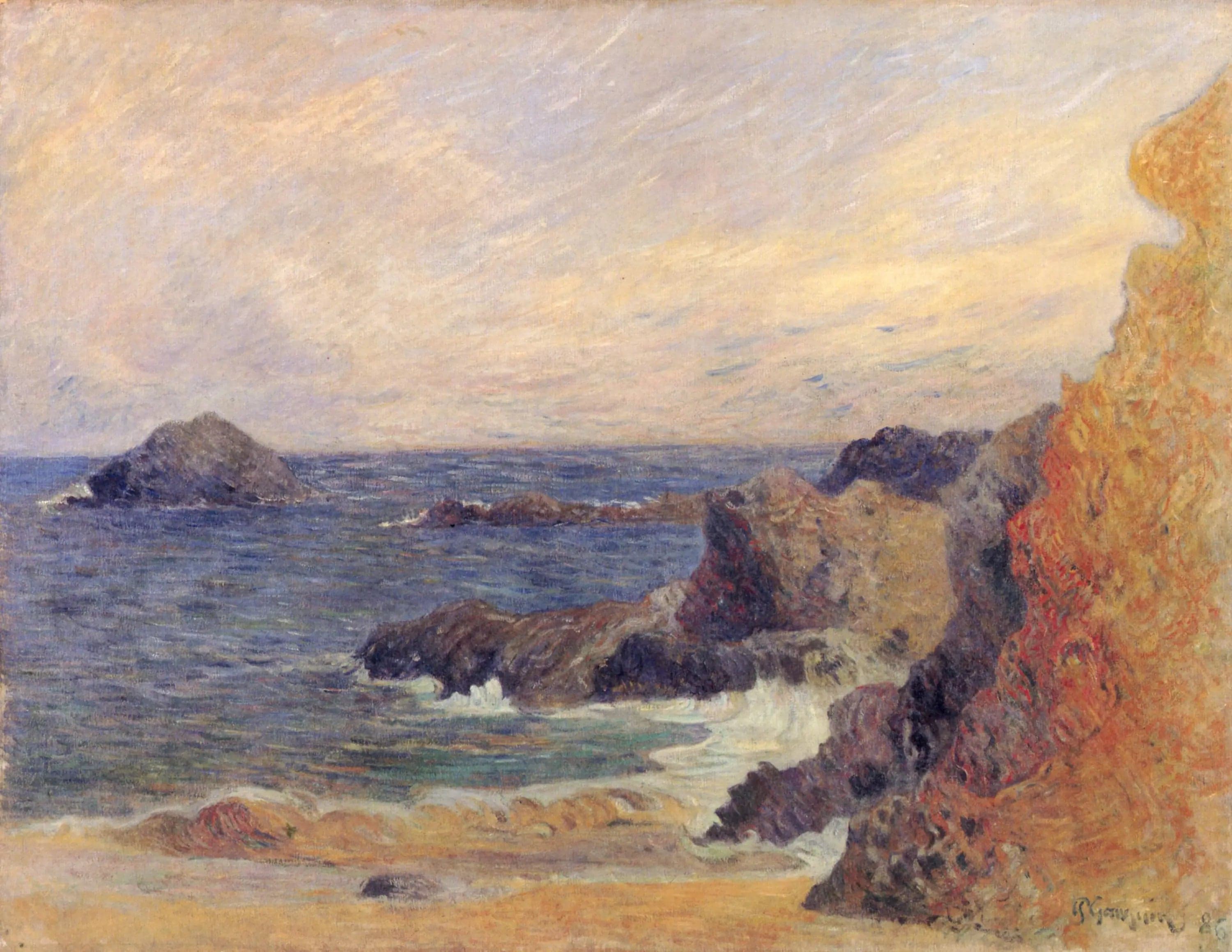
The Rocky Coast
- Original dimensions
- 91.3 x 70.5 cm
- Museum
- Gothenburg Museum of Fine Arts
- Year
- 1886
Scene depicted
In this masterpiece , the scene depicts a wild landscape of Brittany, its imposing rocks emerging from the tumultuous waves. The bold hues and stylized forms capture the raw essence of nature, while the sky, mixed with a rich palette, seems to vibrate to the rhythm of the sea. This pictorial work reveals the eternal dialogue between man and the natural element that surrounds him, encapsulating the fragile beauty of the coasts.
Historical context
Created in 1886, this painting is rooted in the vibrant context of Brittany, a fertile period for Gauguin, who was in search of new artistic expressions. Belonging to the post-impressionist movement, The Rocky Coast is part of an era where art breaks free from conventions to explore emotions and sensations. Today, this canvas shines at the Gothenburg Museum of Fine Arts , offering visitors a journey through time and space, while reminding them of its imposing dimensions.
Place in the artist's career
The Rocky Coast marks a turning point in Gauguin's career, an artist in full evolution. This painting illustrates his shift towards a more pronounced abstraction, while echoing other works such as Vision After the Sermon and The Siesta . Each composition bears witness to his desire to merge form and color to transcend reality.
Anecdote
Gauguin once stated: “Painting is a silent voice, it speaks without sound.” These words resonate deeply with The Rocky Coast , where each brushstroke evokes the calm of a misty morning on the Breton shores. This painting is a reflection of a suspended moment, a silent encounter between the artist and the nature that fascinates him.