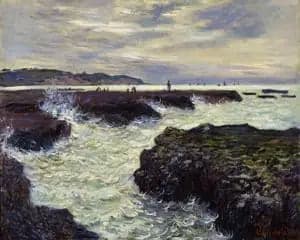
The Rocks at Pourville, low tide.
- Original dimensions
- 78.7 x 64.3 cm
- Museum
- Memorial Art Gallery
- Year
- 1882
Scene depicted
On this canvas, the low tide reveals the beauty of the rocks sculpted by time, while the sea recedes, giving way to a landscape of gradients and textures. The atmosphere is both calm and dynamic, like a breath of nature. The waves blend with the clay of the shores, while the shadows dance subtly on the sand. It is a fleeting moment, brilliantly transcribed by Monet's hand.
Historical context
Year: 1882 |BRK| Museum: Memorial Art Gallery |BRK| Dimensions: 78.7 x 64.3 cm
Place in the artist's career
“The Rocks at Pourville , low tide” is part of a period of maturity for Monet, where his technique becomes increasingly bold. Alongside works such as “ Impression, Sunrise ” and “ The Saint-Lazare Station ”, this painting shows an evolution towards a more intimate dialogue with light and movement. These compositions reveal not only Monet's impeccable talent but also his exploration of natural elements.
Anecdote
“I paint what I see, and what I feel,” could have said Monet while walking along the shores of Pourville . Imagine a spring morning, when the sun's rays gently caress the rocks, illuminating the shades of the dunes. This scene, imbued with serenity, nourished Monet's creative soul and gave birth to a masterpiece that resonates with eternity.