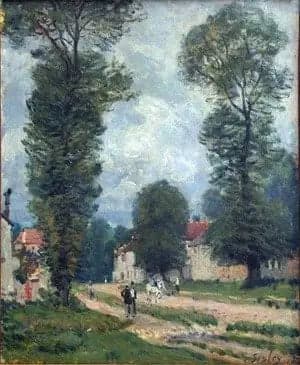
The Road to Versailles
- Original dimensions
- 38 x 47 cm
- Museum
- Orsay Museum
- Year
- 1875
Scene depicted
In this masterpiece, Sisley takes us along a verdant path lined with majestic trees, where the tranquility of nature mingles with the magic of soft and vibrant light. This painting invites us to a contemplative stroll, where the sound of leaves and the play of shadows create an almost palpable atmosphere, paying tribute to the beauty of French landscapes.
Historical context
It was in 1875 that the English artist Alfred Sisley , an iconic figure of Impressionism , created this painting in the beautiful region of France, more specifically in Versailles, a city rich in history and splendor. This painting, now exhibited at the Orsay Museum , illustrates not only the Impressionist movement but also the essence of the era, marked by a deep respect for nature and a quest for light. Its dimensions, 38 x 47 cm, make it a work full of delicacy and intimacy.
Place in the artist's career
The Road to Versailles stands as one of the major works of Alfred Sisley , reflecting his growing mastery in rendering light and atmospheres. At this time, Sisley had already created other notable paintings such as "The Garden of the City of Argenteuil" and "Impression, Sunrise," both emblematic of his quest for a personal definition of Impressionism , where emotions come to life through color and light.
Anecdote
“To paint is to capture the moment, it is to dance with light,” Sisley might have said one spring morning, as he observed the vibrant foliage bathed in golden light. In this canvas , each brushstroke evokes a peaceful and serene scene, marked by this quest for beauty, which is at the very heart of his artistic approach.