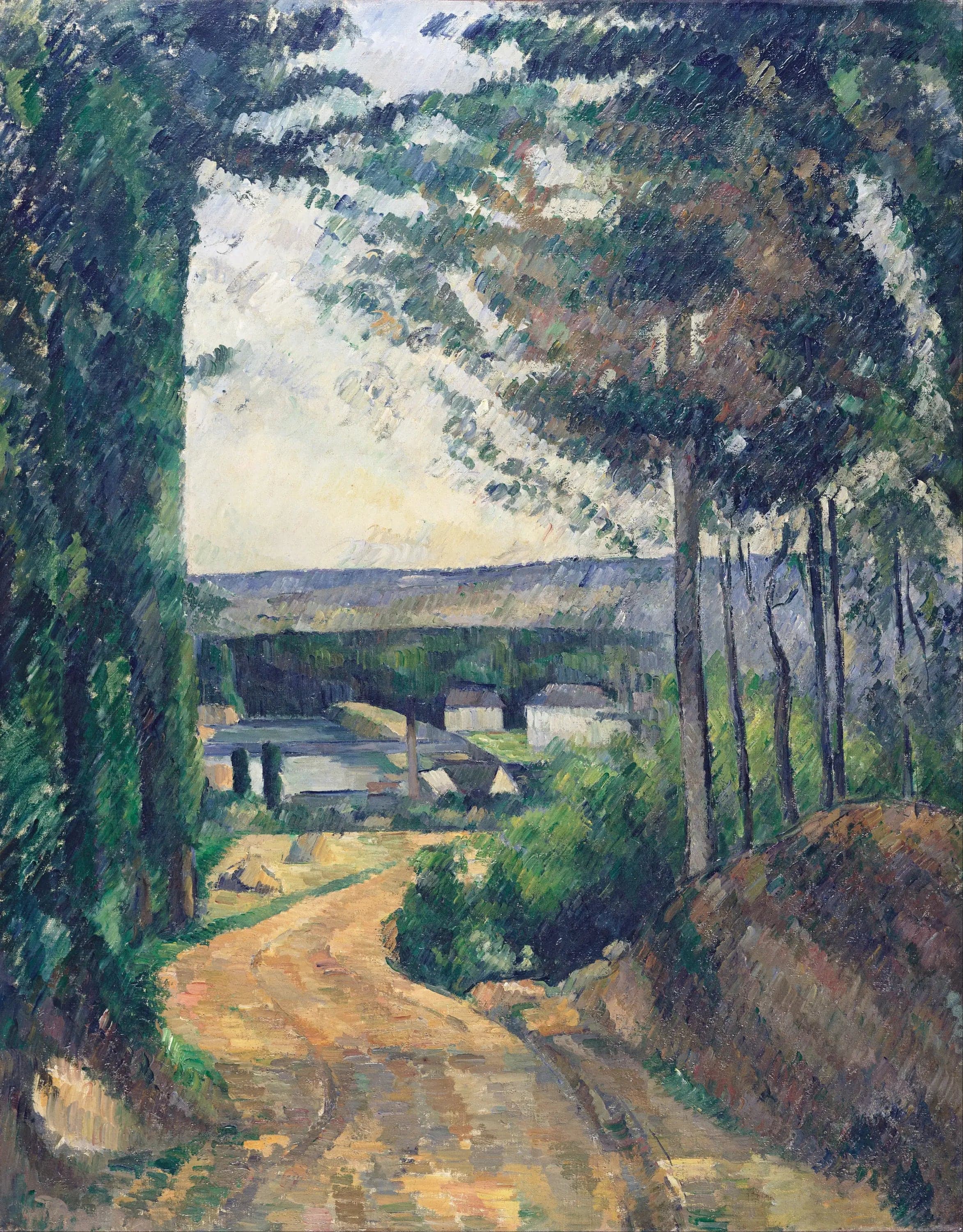
The Road to the Pond
- Original dimensions
- 750 x 920 cm
- Museum
- Kröller-Müller Museum
- Year
- 1880
Scene depicted
This pictorial work reveals a winding path leading to a tranquil pond, framed by greenery. The soothing tones of the water reflect the sky, while the light plays among the trees, inviting the viewer to immerse themselves in this serene atmosphere. Cézanne's landscape seems to vibrate with life, where every blade of grass and every leaf tells a story.
Historical context
Created in 1880, The Road to the Pond is set in the lush surroundings of Aix-en-Provence, a beautiful city in the south of France. This iconic painting , a symbol of post-impressionism , stands out for its innovative vision of light and nature. Today, this canvas is preserved at the Kröller-Müller Museum , an art haven in the heart of the Netherlands, where it continues to amaze visitors with its generous dimensions.
Place in the artist's career
The Road to the Pond holds a prominent place in Cézanne's artistic evolution. Situated at a turning point in his career, this painting demonstrates his growing mastery of landscape, akin to other works such as “Mont Sainte-Victoire” and “The House of Jas de Bouffan,” where the artist explores feelings through nature while innovating his technique.
Anecdote
“Art is a way of experiencing nature differently,” said Cézanne. One spring morning, while observing the light filtering through the foliage, he felt inspired to create this work. The delicacy of the scene in The Road to the Pond is a return to that original emotion, encapsulating a fleeting yet eternal moment.