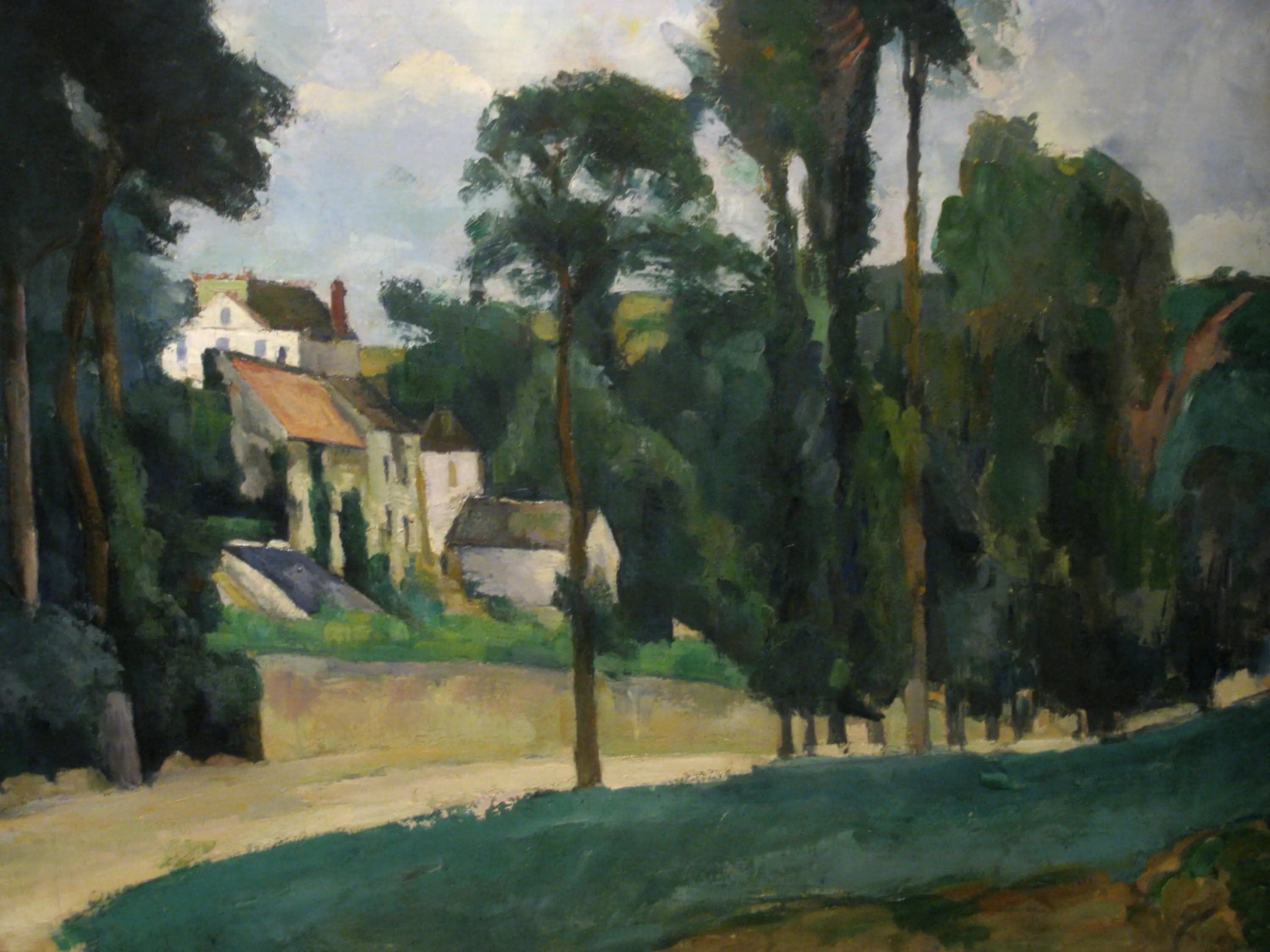
The Road to Pontoise
- Original dimensions
- 71 x 58 cm
- Museum
- Pushkin State Museum of Fine Arts
- Year
- 1875
Scene depicted
The painting “The Road to Pontoise” depicts an idyllic bucolic scene, where light plays with shadows and where the green of the trees contrasts with the earthy tones of the paths. The simplified forms and the rigorous construction of the composition convey the unbreakable bond between man and nature, while capturing a fleeting moment of rural life. A sense of movement is palpable, as if this painting wanted to tell a story with each brushstroke.
Historical context
Created in 1875, this exceptional painting is part of the post-impressionist movement, marking a time of transition and artistic experimentation. Located in Pontoise, a once peaceful town on the banks of the Seine, The Road to Pontoise reflects the importance of this region in Cézanne's creative journey. Today, this fascinating painting is housed in the Pushkin State Museum of Fine Arts in Moscow, where it continues to enchant visitors with its imposing size and unique atmosphere.
Place in the artist's career
The Road to Pontoise represents a pivotal work in Cézanne's career, blending his characteristic style with the exploration of landscapes. Alongside his other iconic paintings , such as “The Large Bathers” and “Mont Sainte-Victoire,” this composition reveals his artistic evolution towards a new abstraction, a precursor to a bright future in the art world.
Anecdote
“Nature is a storm of colors and shapes,” said Cézanne, capturing the very essence of his inspiration. It was on a calm morning in Pontoise, as he wandered along a country road, that his gaze fell upon this picturesque landscape, revealing all its richness. This pictorial work , imbued with emotion, evokes a meeting between the artist and nature, resonating with feelings of peace and contemplation.